
The earliest forms of newspaper were handwritten and now ‘The Musalman‘ probably is the last handwritten newspaper in the world. This Urdu language newspaper was established in 1927 by Chenab Syed Asmadullah Sahi and has been published daily in the Chennai city of India ever since.
It is presently run by Syed Asmadullah's grand son Syed Arifullah and six skilled calligraphers work on this four pages newspaper everyday. With a circulation of approximately 23,000 the paper covers news in Urdu language across a wide spectrum including politics, culture and sports.
With the recent technological advances, where paper newspapers are going extinct because people read them online, this personable touch is rare to find. The price of this paper is 75 Paise (approximately 2 US cents).
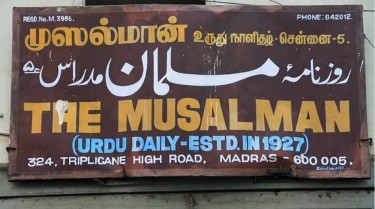
Signboard of the office. Screenshot from the video The Musalman
MadanMohan Tarun reports:
Presently it is edited by Mr. Syed Arifullah. He took over the charge after his father died. His father ran this paper for 40 years. It was founded by his grandfather in 1927. This paper has maintained its original look and had not compromised with the Urdu computer font. [..]
Preparation of its every page takes about three hours. After the news is received in English from its part time reporters, it is translated into Urdu and Katibs – writers, dedicated to the ancient art of Urdu calligraphy, pen – down the whole story on paper. After that negative copy of the entire hand –written paper is prepared and pressed on printing plates.
Afsar Shaheen comments in a post of Luthfispace elaborating why lithography is still being adopted:
Urdu type setting was very difficult; also, typeset work looked ugly in comparison to handwritten work. Therefore, Urdu resorted to lithography while other languages adopted typeset.
With the advent of computer, Urdu writing got great boost. It allowed calligraphic writing without the problems of lithography. Yet, a book or newspaper written by a good katib and properly lithographed is very pleasing and beautiful; computer written Urdu is no match.
Check out this video directed by Ishani K. Dutta and produced and uploaded to YouTube by the Public Diplomacy Division of India’s Ministry of External Affairs:






7 comments
Is it really handwritten? Or is it more hand-laid out. But fascinating nonetheless
It seems more like “written by hand, then Xeroxed”. Still no small feat.
The point is it’s not made with mechanical type, or with a digital font, each glyph is manually shaped every time it appears on the page.
This is a process that became obsolete in Europe hundreds of years ago, think about the difference between old Christian manuscripts and a printed bible.