
Norway Hosts First Journalism Award for Indigenous Broadcasters

This post is part of our special coverage Indigenous Rights.
Norway is widely known for hosting the prestigious Nobel Peace Prize Awards. This month, the Scandinavian country is hosting the debut of another important yet largely unknown journalism award ceremony for the World Indigenous Television Broadcasters Network (WITBN) on March 29, 2012.
Nine finalists have been selected out of 24 entries in the indepth reporting category of the WITBN Indigenous Journalism Awards (2012 WIJA). The ceremony will be held in Kautokeino, Sápmi, Norway.
The official announcement from WIJA explains:
2012 WIJA is the first international Indigenous journalism award dedicated to presenting Indigenous perspectives through journalism in television and audiovisual media. While journalistic standards and ethics are the essences of this honor, the awards in particular look for the portrayal of Indigenous perspectives on stories of local, national or international impact.
This videos shows the 2012 finalists from indigenous networks in developed countries such as Taiwan, Australia, Norway, Canada, New Zealand, and the United States.
One of the nominated programs, from Māori Television, Aotearoa New Zealand, covers what should be labeled as “Occupy Easter Island” (it started a year before the Occupy movement in the U.S.), a rarely reported protest by Rapanui activists who occupied a government-owned hotel for half a year, demanding recognition of Indigenous rights and demonstrating the unfairness of occupation.
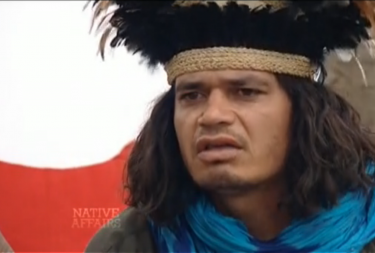
'We are ready to die for our land' says Rapanui activist in program broadcast by Maori Television of New Zealand
Easter Island (or Rapa Nui) is a land where colonization has forced the indigenous population to a small corner of the land, and where tourism had created an unsustainable economy. The sustainability problem is widespread in indigenous peoples’ struggles all over the world to survive and preserve their culture.
The indigenous use of broadcast journalism and modern technology to promote the rights of their communities is a step forward. Read more about the finalists and their programs, here.
- AMAZIGH NRK Sápmi Norway
- AMNESTY CHIEF VISIT TO UTOPIA National Indigenous Television, Australia
- JOURNEY HOME Aboriginal Peoples Television Network, Canada
- KIMBERLY GAS HUB SERIES National Indigenous Television, Australia
- POLITICIAN REPORTS HIMSELF TO THE POLICE NRK Sápmi, Norway
- TE PITO O TE HENUA Māori Television, Aotearoa New Zealand
- THE VALUE OF WATER ‘Ōiwi TV, Hawai’i
- VUVU’S LAST PIECE OF LAND Taiwan Indigenous Television, Taiwan
- WATER EXPLOITATION Aboriginal Peoples Television Network, Canada
This post is part of our special coverage Indigenous Rights.





3 comments
I believe that it is fantastic for these awards to be held so that the Indiginous people can get appreciation for their style of journalism which is none the less different from the journalism from much larger countries. It is also a great way to bring Indiginous populations from all around the world together!