Latest posts by Silvia Viñas
Mapping Conflicts Between Indigenous Peoples and Corporations in Latin America
Codpi (Coordination for the Rights of Indigenous Peoples) has created a map to monitor projects that are affecting indigenous territories, as their website explains [es]: This map aims to collect cases of conflict that arise due to the presence of transnational corporations -mainly those with headquarters in Spain- in the...
Why You Should Stop Saying ‘Venezuelan Women are Beautiful’
The pressure to conform to an impossible standard of beauty was, and is, incredible. Why? Because if you do not nip, tuck, fill and blow-dry your way towards “beauty,” then you will be the exception to the rule, you will be “un-beautiful,” you will break the mantra that we all...
Do You Have What it Takes to be a Mexican Newspaper Editor?
On PBS.org you can take “The Reportero Challenge”, a game inspired by the documentary Reportero which presents various scenarios that journalists and editors face in Mexico: You have been offered the position of Editor-in-Chief at El Centinela-Investigador. Since its inception, the paper has stood up to the drug cartels and a...
El Salvador and Costa Rica to Hold Runoff Elections
El Salvador and Costa Rica held presidential elections yesterday, February 2, but both countries will define their president in a runoff vote. In El Salvador, “results show Salvador Sanchez Ceren (FMLN) winning 49%, just short of the 50% he needed to win in the first round. Norman Quijano (ARENA) is...
Voting Day in El Salvador
Online news site El Faro has published a Storify post [es] with early citizen reports and reactions about today's presidential elections in El Salvador. They also have a special section [es] dedicated to the elections where they share photos, tweets and more. Meanwhile, Tim's El Salvador Blog has put together...
Costa Ricans Go to the Polls to Elect a New President
Glenda Umaña, a Costa Rican journalist who is covering today's presidential elections, comments on Facebook [es] and Twitter: Ya me encontré en padrón electoral. Se me salen las lágrimas de la emoción de votar! #CNNTICO @cnnee @ pic.twitter.com/RHua1KrN8L — Glenda Umaña (@glendacnn) February 2, 2014 I found my name on...
Memes to Confront Impunity in Mexico
David Sasaki shares viral videos and social media memes from Mexico to show how “the meme has been embraced by a Mexican middle class as a tool to confront the impunity of the country’s elite.” For example: In the same way that literature inevitably builds on the books of the...
According to Google Autocomplete ‘Colombia is Passion’ and ‘Mexico is Culture’
Colombian blogger Javier Moreno typed “[Name of country] is” on Google search to see auto-complete suggestions for each country in Latin America and Europe. He modeled his experiment after the English version of the Google search “Why [country] is.” From his search in Colombia he got results like “Ecuador is...
Ecuador's Indigenous People: “We believe in development that respects Mother Earth”
“The Government is appropriating our spiritual values of the Amazon region, it’s seeking to deconceptualize our cultural concepts”, says [Carlos Pérez, President of ECUARUNARI (Confederation of Kichwa Peoples of Ecuador)]. “It doesn’t know what Pachamama is. It doesn’t understand the rights of nature. It doesn’t understand Sumak Kawsay (good living),...
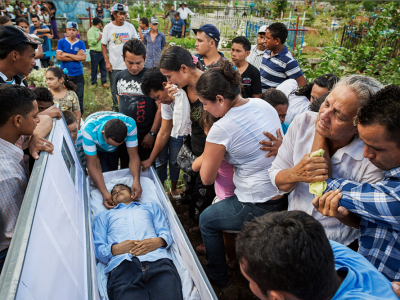
Putting Faces on the Mysterious Disease Killing Nicaraguan Sugar Cane Workers
A fatal disease is killing sugar cane workers in Nicaragua. Photojournalist Ed Kashi wants to raise awareness about this mysterious epidemic through a documentary project that is looking for funding.
Nicaraguan Micro-Fiction by Alberto Sánchez Arguello
Blogger Mildred Largaespada of 1001 Trópicos [es] writes about Alberto Sánchez Arguello, a Nicaraguan writer who shares his micro-stories through his Twitter account @7tojil [es]. “He is definitely an outstanding representative of Central American writers 2.0 who use new formats and genres”, she writes. Mildred also shares two micro-stories written...
10 Documentaries on South American Music to Watch Online
Nick MacWilliam from the blog Sounds and Colours has compiled a list of 10 documentaries, “looking at all manner of musical styles and movements from the region, with films focused on Brazil, Argentina, Colombia, Chile, Peru and Venezuela.” This list makes no attempt to rank the films, nor does it...
Gender-Based Violence Epidemic Hits Sex Workers in Honduras
Despite the fact that sex work is legal in Honduras, many groups and individuals view their actions as immoral. Those who murder sex workers believe they can literally treat these human beings as garbage to be disposed of. Such violence takes place against the broader backdrop of widespread gender- and sexuality-based violence...
Online Platform ‘Ojo al Voto’ Seeks to Lure Young Costa Rican Voters
The interactive platform Ojo al voto [es] wants to provide young voters with useful and straightforward information about the upcoming presidential and legislative elections in Costa Rica, scheduled for February 2, 2014. The Hivos Central America website explains: Ojo al voto is an interactive platform, independent from the mainstream media,...
Hydroelectric Projects in Panama: “Promised Development But Created Disaster”
Although dam developers and governments insist that local communities benefit from these projects, the reality on the ground in Panama suggests the opposite: communities are plunged further into poverty, environments are destroyed and irreparable harm is caused. As one witness who is living in the wake of the Chan 75...
Candidates Face Off in First Presidential Debate in El Salvador
Tim's El Salvador Blog summarizes the first presidential debate ever held in El Salvador: The three leading presidential candidates Norman Quijano (ARENA), Salvador Sánchez Cerén (FMLN), and Antonio Saca (Unidad), were joined on the stage by two minor candidates, Óscar Lemus (FPS) and René Rodríguez Hurtado (PSP). The debate had...
Colombians March in Support of Dismissed Bogotá Mayor
Supporters marched in Bogotá and in other major cities to support Mayor Gustavo Petro, who was dismissed from his duties by Colombia's Inspector General Alejandro Ordóñez Maldonado and banned from public office for 15 years. Mike's Bogotá Blog shares photos and an account of the march on January 10, 2014:...
Latin America's Black Metal Fans, Punks and Otakus
Santiago, Lima, Mexico City and Oaxaca have been some of the cities in which photographer Carla Mc-Kay has photographed punks, thrashers, transvestites, black metal fans, new waves and otakus, recording their everyday lives in their habitat. Sentidos Comunes has published Carla Mc-Kay's photographs in a photo essay titled “Street Youth”...
El Salvador Prepares for Upcoming Presidential Election
Salvadorans will go to the polls on February 2, 2014, to elect a new president. Jorge Kawas in PulsAmerica explains: Polls show that the election will be a close call between the left-wing Farabundo Marti National Liberation Front (Frente Farabundo Martí para la Liberación Nacional – FMLN) and the right-wing...
“Social Media for Journalists”, a New Massive Online Course
The Knight Center for Journalism in the Americas is offering a new Massive Open Online Course (MOOC): “Social Media for Journalists: The Basics.” The free course in English starts February 3 and ends March 9, 2014. The MOOC will give students an overview of the use of social media in...
Indie Voices: Connecting Investors With Journalism Entrepreneurs in Developing Countries
In the Knight Center's Journalism in the Americas Blog, Alejandro Martinez writes about a new crowdfunding platform for independent journalism projects called Indie Voices: Indie Voices seeks to become a meeting ground between entrepreneuring journalists and investors, where the former can find different sources of funding and put together their...