
9/11 Retrospective: The Birth of a Generation
This post is part of our special coverage Global Voices 9/11 Retrospective.
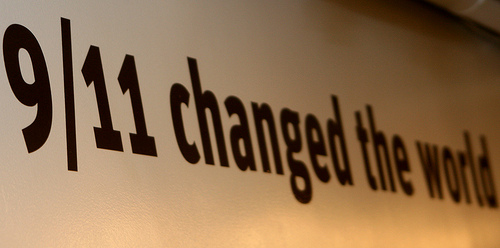
New York 9/11 Museum, photo by PeterJBellis (CC-BY)
Ten years have passed since the coordinated 9/11 attacks on the USA by al-Qaeda; that one event altered the way the West interacted with the Middle East, changed attitudes towards Islamism, and introduced new restrictions regarding travel and border crossings. All this is discussed by young people from all around the world through a series of short videos, reflecting on coming of age in the post 9/11 era.
Salmaa Elshanshory lived in Texas at the time of the attack, and as a Muslim American she felt both the negative stereotypes borne from ignorance as well as the support, kindness and generosity of the community which came together to help strangers after the attacks. She prefers to think of her generation as one where people learned to stand next to strangers in the face of uncertainty and move on reacting in a positive manner.
Hisham Almiraat from Morocco [Disclosure: Hisham is a collaborator for Global Voices Online] felt misrepresented as a Muslim and Arab: not only by the government, which failed to acknowledge that there were people who did not support their attack, but also the media and by the attackers themselves, who declared that they had done so on Arab's behalf. Ten years afterwards, he has seen the decrease in popularity for Arabic autocratic regimes, fanaticism and extremism, and a rise in popular movements struggling and managing to topple these regimes to replace them with a more egalitarian society.
Generation 9/11: Hisham Almiraat (Morocco) from British Council USA on Vimeo.
Hungarian Krisztian Gal reflects that even though they were geographically removed from the events, firefighters in his city and schools all took action to remember those who lost their lives during the attacks. What he realized is that being outside of the events allows people to have a different perspective on what is going on, and that connecting to different cultures and nations is a way to get a better grasp of world politics and international relations he decided to include this new insight into his work and life.
Generation 9/11: Krisztian Gal (Hungary) from British Council USA on Vimeo.
Cristina Balli in Texas remembers how fear possessed her community and how borders were scapegoated as the sources of danger. Immigrants in general became something to be feared and it turned into an Us Vs.Them situation, even though the attackers hadn't come in through the Mexico-US border and the communities had nothing to do with the attack. The previously fluid border where cultural exchanges had taken place for generations became a wall, and she says it completely affected the dynamic and changed the way of life in her town.
Generation 9/11: Cristina Balli (USA) from British Council USA on Vimeo.
More videos are available on the Generation 9/11 video project website. The project is a joint endeavor of the British Council's Our Shared Future and Transatlantic Network 2020.
This post is part of our special coverage Global Voices 9/11 Retrospective.





1 comment