
Canada: The ‘Disappearance’ of Native Women
This post is part of our special coverage Indigenous Rights.
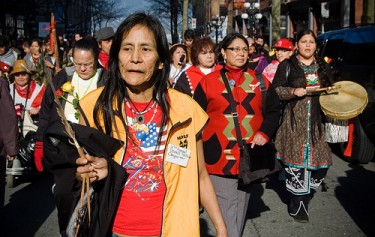
Canadian women at the 19th Annual Missing Women's Memorial March in February 2010
As August 30 marked the International Day of the Disappeared, news from Canada that nearly 600 native women have gone missing over the past three decades has spread far and wide and throughout the Canadian blogosphere. Human rights activists claim that the Canadian government has not done enough to investigate the disappearances. Most of the women are thought to have been murdered. There is also suspicion that some may have been the victims of extra-judicial killings.
A racist system?
American blogger Kera Lovell was surprised to learn of Canada's high rate of missing native women:
Everyone loves Canada, eh? And no one can give you any specific details about Canada other than: two Olympics were held there, in Quebec they speak French, and, that it’s known for ice wine, ice hockey, and syrup. And Michael Moore is from there.
But what about their issues? Assuredly Canada deals with similar problems of race, class, gender, etc, but you never hear about Canada, so it must be fantastic there. Right?
I recently learned from this Rabble news article posted on Racialicious that Canada has a high rate of missing and murdered native women, totaling nearly 600 women over the past 25 years, and half since the year 2000. And more than half of these murders remain unsolved. WTF?
Native American paper Indian Country Today is publishing a four-part series on the disappeared women. Part 4, published on August 25, discusses Canada's policies toward its indigenous population in relation to the disappearances. In a comment on the post, NY Indian Girl writes:
A SYSTEM is to blame. That system has been planted in the minds of Natives in Canada, the U.S., etc. The system has become a mindeset of no self worth, forced assimilation, forced removal from homelands,etc. Just as the slaves had a systemic mindset put in them, the same was done to ALL Indigenous people. When your people are murdered for their land by a foreign nation and then forced to take on the thought process and lifestyle of that nation, it breaks down who you are and gives the oppressor the hold on you that is needed to keep you down. None of these people asked for what has befallen them. And once the cycle started, it has been hard to break. So do not put blame at the door of those who did not ask for what happened to them, put blame on those who stole from them and forced them to take on lives that were not and still are not their own. My ancestry is both of slaves and Native Americans, so I see both sides. Thanks for the story.
The role of the media
Blogger Patricia, writing for Citizen Shift, reporting on a Montreal workshop on violence against women, writes of the media's role in the disappearances:
There are 520 cases of reported missing native women in Canada. What is so alarming, says Robertson is how the police and media fail to acknowledge this. “Native families don’t know who to turn to.” Robertson used a horrible example of three young native women who went missing in Quebec in 2006. Around the same time a lion cub disappeared from a zoo. This got a lot of coverage but the women’s stories did not. Police did not want to interfere because the reserves come under federal jurisdiction and these young women were from reserves. The story had a very tragic end when the body of Tiffany Morrison from Kahnawake was found this summer near the Mercier Bridge.
Trisha Baptie, writing for She Loves Magazine, calls on the public to pay equal attention to the plight of indigenous Canadian women:
My Facebook news feed has been a constant stream of two things this past week: one is of a white, 30-something, tall (very tall, actually) man with size 16 feet named Tyler who went out hiking two weeks ago and has not been seen nor heard from since. Tyler is great. We have many friends in common; he’s a pro hiker and I hope and believe he will be found soon…
…Truth be told there are hundreds of missing–mostly aboriginal–women all across Canada. What is different in these two stories is that there is no expense being spared for Tyler. In fact, there are fundraisers being held in the search for Tyler, yet no one is pulling out all the stops to find my sisters. In the words of Laura Holland, a member of the Aboriginal Women’s Action Network (AWAN): “My sisters, my perfect sisters were not considered perfect enough victims and witnesses for the Vancouver prosecutors and police.” And therein lies the problem. Understand this is a hard topic to tackle. Understand I want Tyler found. I pray he is safe. I want helicopters, infrared cameras, rescue teams and everything that can be used, to find him.
My question, though, is why society is not doing it for the women missing across this country? Why in the name of “unstable lifestyle” “addiction issues” “homeless” and “prostituted women” do we get to abandon them? Why is their marginalization by society the very excuse we use not to pursue them with all our heart. With God’s own heart? Didn’t he seek out the one sheep that got away from the flock? Isn’t Jesus’ take-home message Love the least of these?
Photo by nofutureface made available under a Creative Commons Attribution 2.0 Generic license
This post is part of our special coverage Indigenous Rights.








7 comments
You are right, this is an issue we never hear about. Thank you Jillian!
Thanks for letting me know about this Jillian! The numbers are staggering!
Michelle
It is even more startling to realize that the Aboriginal population in Canada is not that large. So the number of missing Aboriginal women is high. The media can play a role in putting pressure on authorities to make the missing women a priority. However, labels are quick to place a less importance on the women; high risk life style, prostitutes, and all the other good stuff. So they are partially to blame for their woes. The serial killer in British Columbia has exposed the media and the police for their attitude towards women. Many families reported their sisters missing. Police were quick to say that they will turn up, they just live on the streets and that behaviour is normal. There are women in Manitoba Canada, that are working real hard to keep the missing on the minds of the people. They can’t be and shouldn’t be missing in body and in spirit.
A woman decides to have a facelift for her 50th birthday.
She spends $15,000 and feels pretty good about the results.
On her way home, she stops at a news stand to buy a newspaper.
Before leaving, she says to the clerk, “I hope you don’t mind my asking, but how old do you think I am?”
“About 32,” is the reply. “Nope! I’m exactly 50,” the woman says happily.
A little while later she goes into McDonald’s and asks the counter girl the very same question.
The girl replies, “I’d guess about 29.” The woman replies with a big smile, “Nope, I’m 50.”
Now she’s feeling really good about herself. She stops in a drug store on her way down the street.
She goes up to t he counter to get some mints and asks the clerk this burning question.
The clerk responds, “Oh, I’d say 30.” Again she proudly responds, “I’m 50, but thank you!”
While waiting for the bus to go home, she asks an old man waiting next to her the same question.
He replies, “Lady, I’m 78 and my eyesight is going.
Although, when I was young, there was a sure-fire way to tell how old a woman was.
It sounds very forward, but it requires you to let me put my hands under your bra.
Then and only then can I tell you EXACTLY how old you are.
They wait in silence on the empty street until her curiosity gets the best of her. She finally blurts out, “What the hell, go ahead.”
He slips both of his hands under her blouse and begins to feel around very slowly and carefully.
He bounces and weighs each and he gently pinches them.
He pushes both together and rubs them against each other.
After a couple of minutes of this, she says, “Okay, okay…How old am I?”
He completes one last squeeze and then removes his hands and says, “Madam, you are 50.”
Stunned and amazed, the woman says, “That was incredible, how could you tell?
The old man says, “Promise you won’t get mad?”
“I promise I won’t.” she says.
“I was behind you in line at McDonald’s!”
Here is a way to gain and maintain empathy for others, excerpt below: http://llavealhighway.com/amazing_aztecs/
I think as US citizens we have a lot of hard work to do. The yin and yang of this nation as a whole, can be:
yin-gaining knowledge from around the world,
empathy. Reading, traveling quietly to other places, speaking with
community elders, asking questions to those of other cultures and simply
listening to the answer.
yang-changing structure of US culture to integrate
worldly knowledge. Supporting local places like YMCA and cultural
exchanges, finding ways to take care of self so that can be open to
influence from others.