Stories from 2 February 2010
Russia: Photos of Deserted “Zenith” Business Center

IZO links to LJ user sd_group‘s summer 2008 photos (RUS) taken inside the deserted “Zenith” Business Center – “that huge 1990s blue-glass building you see when you come out of Yugo-Zapadnaya metro.”
Russia: Muscovites on Moscow mayor
GUS News discusses [GER] a recent Levada center opinion poll [RUS] on how Moscow citizens perceive the financial relation between their mayor and his wife – Russia's wealthiest businesswoman.
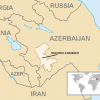
Armenia-Azerbaijan: Twitter Diplomacy
With a peaceful resolution to the conflict over Nagorno Karabakh as elusive as ever, Armenians and Azerbaijanis are unable to visit each other’s country or communicate through traditional means such as telephone or mail. Can new and social media step in to fill the gap to break the information blockade?
Eastern Europe: What purpose of Nabucco pipeline?
Eternal Remont comments on a Wall Street Journal interview with the Nabucco gas pipeline director, who claims that the Nabucco project will serve as merely a complement to Russian gas flow to the West, and not – as previously envisaged – a substitute for it.
Russia: A lost year for the economy
Gabriela Ionita of Power&Politics World posts an interview with Russian economist Vladimir Inozemtsev, who characterizes 2010 as a lost year for Russian economy.
Global Voices and Google announce freedom of expression award jury
The Breaking Borders Award is a new prize created by Google and Global Voices and supported by Thomson Reuters to honor outstanding web projects initiated by individuals or groups that demonstrate courage, energy and resourcefulness in using the Internet to promote freedom of expression. We are proud to announce our...
Cuba: Outside the Boxing Ring Photos
Roberto Suárez of the blog Cuba en Fotos [es] posts some of his photographs of what happens outside of Cuban boxing rings.
Estonia: Distancing the past
Itching for Eestimaa reflects upon a not too distant soviet past, which still seems far away even to middle aged Estonians of today.
Haiti: Marathon Man
As Haiti drops from being the lead story in the mainstream media, how can they hear stresses that “what Haiti needs most are those that are ready to run the marathon, not just run the 100 yard sprint.”
Haiti: Measurable Map?
The Life and Times of the Mangine Many republishes a map of the damage in Haiti from the Office for the Coordination of Humanitarian Affairs, while The Livesay [Haiti] Weblog wonders “how anything like this can ever be quantified.”
Lithuania: Repeated refinery row?
Lituanica reports that the old Mazeikiu oil refinery may be up for sale again, and that Russian interests are among key prospective buyers. In 2006, the sale of Mazeikiu Nafta caused bilateral crisis between Lithuania and Russia.
Haiti: Breast Not Best in Emergencies?
Repeating Islands discovers that “the conditions [in Haiti] are still too precarious for reliable delivery of breast milk.”
Haiti: Human Trafficking
The Haitian Blogger gives an update on the story of American “missionaries” trying to take children out of Haiti without proper documentation: “A problem in Haiti which is heightened by the catastrophic earthquake is child trafficking. Thankfully, the 10 Missionaries who attempted to move 33 orphans into the Dominican Republic...
Trinidad & Tobago: Shiva's “Fireflies”
Repeating Islands reports that “the late Shiva Naipaul, younger brother of V. S. Naipaul, has been put on the long list for the lost Man Booker Prize that seeks to honor books published in 1970.”
Trinidad & Tobago, Haiti: Tough Questions
“Our conversation begins and ends with Haiti, but digresses down some of the anxious paths my thoughts seem to trace these days”: Nicholas Laughlin has a chat with Scott McLemee.
Jamaica: Last of the “Drumblairs”
Geoffrey Philp acknowledges the passing of Albert Huie, the last survivor of the “Drumblair” group of intellectuals and artists that drove the national movement for Jamaican Independence.
Taiwan: Prison important for education
Brennpunkt Taipeh writes about the changes to the Jingmei Detention Centre over the past one and half years. He argues that the place is important for educating Taiwanese people about their history. The Jingmei site was used to detain political prisoners during the White Terror period in Taiwan.
India: The Zero Rupee Note
Priyanka Borpujari informs that 5th Pillar, an NGO based in Washington DC and with offices in India in Chennai and Delhi, “has developed zero currency notes that one could print and give to government officers, each time they ask for a bribe.” Fumiko Nagano at World Bank Blog has details.
Cambodia: Reviewing the anti-corruption law
Bloggers react to the proposed anti-corruption law in Cambodia. They also suggest ways on how to combat corruption in society
Maldives: Failures In Maldives Politics
Mohamed Naahii lists top 3 biggest failures in Maldives Politics according to his opinion.
Nepal: Adventure In Entrepreneurship
Sandeep Giri describes how after confronting with energy problem while running a project in Kathmandu led an entrepreneur like him to commit to a solar energy project that provides solar electricity as a viable backup option for urban homes and businesses in Nepal.