The conflict started last year when the politicians in Nepal started debating the integration of the former Maoist guerrillas, popularly known as People’s Liberation Army (PLA) into the country’s national army (NA). It was predicted then that the process could affect the structure and stability of the national army.
Dr. Divas at ABC reported in January 2009 about a conflict between Defense Minister Ram Bahadur Thapa Badal and the national army Chief Rookmangud Katwal :
Badal and Katwal are at loggerheads over whether the NA should continue with fresh inductions to fulfill the vacant posts in the army. While Badal accuses the Army of trying to control a democratically elected government by refusing its directives, Katwal sounds defiance against the Maoists tactic of keeping the National Army under the Party’s control.
Katwal finds the Maoists ungrateful toward the NA in general and the Maoists find Katwal a major impediment against implementing their agenda. Since then the situation has degraded. Dr. Divas updates on April 23rd on the same post:
Prachanda supported a decision by the defense ministry two days ago to seek clarification from General Katawal over allegations that he ignored government orders on recruitment and the sacking of eight senior army generals.
Neil's Nepal warned of consequences:
The Army has been blatantly violating the principle of civilian control. [..] Not only this, the major opposition party is supporting the army in it’s continual violation, and the Maoists are probably not at the hight of popularity. Now that the Maoists are calling the army chief in for a “clarification,” something that could be a preliminary stage of sacking him, all traditional indicators would be pointing to an army coup. This is a particularly serious concern in light of the fact that the last army coup was a mere four years ago.
But the blogger also provided logic why the coup would not happen:
The PLA is still sitting out in cantonments, it still has it’s arms, and it’s still loyal to the Maoist chain of command. The army chief knows that if he uses some pretext to sack the elected government, he won’t just have to deal with an extremely organized street protest/urban uprising (from a party that is now entrenched in urban areas and highly militant). He’ll immediately have to pit his troops (who may not be so willing) against an 18,000 strong, highly motivated, guerrilla force.
United We Blog! for a Democratic Nepal informs today that some “Generals of Nepal Army had made plans of (a) ’soft coup’ to tackle Maoist’s plan to dismiss the Chief of the Army Staff General Rookmangud Katwal.” Dr. Divas also updates that General Katwal was for executing something within statute, a “Bangladesh-inspired President’s Rule backed by India Government”.
A detailed report has been published in eKantipur.com. It shows that Maoists were planning to integrate all 19,000 former guerrillas (PLA) in the National Army and several PLA commanders would get higher positions.
United We Blog! also posted the army's response strongly refuting the reports as “imaginary and illusionary.”
Neil's Nepal points to the Maoists' advantage:
The Maoists have found their way around this inconvenient fact by forming their own army (through great difficulty) and breaking the governments monopoly on the use of force. Hence, they don’t have the loyalty of the army (at least not the leadership), but they probably aren’t going anywhere anytime soon.

The Liberation Tigers of Tamil Eelam (LTTE) are holding on to just a sliver of land in the north of Sri Lanka, but the United Nations is estimating that 50,000 people are still trapped in the war zone. As fighting surges in the final throes, concerns for civilians is growing and calls for international attention and understanding abound on the Internet and in the streets of cities around the world, such as London, Berlin and Paris. Should we help the Tamils? is now a burning question in Canada.

A Call For Intervention - Tamil protests in Ottawa. Image by Mikey G Ottawa and used under a Creative Commons License
But many bloggers are questioning the information people abroad are getting about the island's long war. The international media reports have been inadequate or inaccurate, while the Sri Lankan government is blocking access of journalists to the north where civilians are in danger.
Prominent Sri Lankan blogger and Sunday Leader columnist Indi Samarajiva of indi.ca calls for the LTTE to release the civilians they are holding and offers a critique of international reporting on the war:
Frankly, I think the ‘International Community’ and international media are far too quick to offer solutions without looking at the situation. And they are, frankly, largely impotent and irrelevant. Note that Al Jazeera is doing real reporting. They have an actual guy on the ground in Palmudai, the anchors ask real questions and so they report that the LTTE is firing on people and holding them hostage.
The other media seems to be like, ‘We don’t understand so, just, er, stop’. Seriously, on CNN I often see the anchor being like ‘I don’t know what’s going on’ and the reporter being like ‘Yeah me neither’ and I’m like, ‘congratulations on publicly sucking at your jobs’. But Al Jazeera does well.
Serendipity adds to the critique, calling out the media for dropping in on the Sri Lanka story too late:
Once again we have been reminded in Sri Lanka of the world of sound bites. The sudden intensity with which the world media have closed in on the last stages of the LTTE is an indication of the short-lived nature of much of journalism, which is in a business to sell or draw an audience in the case of TV. Their intentions therefore are more about sensationalism as opposed to genuine concern for the news they are reporting.
Jeremy Page, South Asia correspondent for The Times in London, offers some explanation why the international media has been hamstrung in its coverage of Sri Lanka. He was turned back at the airport in Colombo after trying to enter on a tourist visa. After being taken into a side room, he was held overnight and then sent out of the country:
A message flashed up on his screen: “DO NOT ALLOW TO ENTER THE COUNTRY.” With that, my passport was confiscated, I was escorted to a detention room, locked up for the night, and deported the next day. I can’t say that I was surprised, though it was my first deportation in 12 years of reporting from China, the former Soviet Union and South Asia.
Despite multiple applications, I’ve been denied a journalist’s visa for Sri Lanka since August. For almost two years, the Sri Lankan Government has prevented most independent reporters from getting anywhere near the military campaign against the Tamil Tigers. So I was trying to enter as a tourist to write about the 150,000 civilians that the UN estimates are trapped in a no-fire zone with the remnants of the Tigers. The only other countries that I can think of where foreign journalists have to pose as tourists are Zimbabwe, Turkmenistan and North Korea.
Still, Andrew Stroehlin writes on Alertnet that just because journalists do not have direct access to the warzone, they do have access to information:
Just because journalists are not allowed into the Sri Lankan conflict zone doesn't mean we don't know what's going on there. We have satellite imagery showing large concentrations of people caught in the fighting, and we have information from reliable sources on the ground. Recent reports that significant numbers of civilians have escaped have not changed the overall figures: independent sources on the ground continue to report 100,000 people or more remain trapped, exhausted, with limited access to food and medicines, and many under fire.
On the Committee to Protect Journalists blog, Asia Program Director Bob Dietz highlights both lack of access and lack of coverage of the war. He posted the comments he made to a U.S. Congressional hearing on Sri Lanka. In his preamble he wrote:
When asked about the lack of access, I told the Lantos Commission yesterday that I still have a question hanging in my head from a meeting with some Sri Lankan students in Ottawa in March. They had made the trip from Toronto to interview me about media issues. One questioned why there is so little international coverage of the fighting in Sri Lanka. “Why,” she asked, “aren't Anderson Cooper and the rest of them standing as close as they can get to the war, just like they did when journalists weren't allowed to enter Gaza?”
I didn't have a good answer for her then, and to tell you the truth, I still don't have a good answer. The two sides are indeed keeping the press out of the conflict zone, but news media worldwide could do more to report what they can and to highlight the restrictions. This is a major human catastrophe taking place in the heart of the Indian Ocean, and it is going virtually unreported save for official statements from both sides to the conflict. That's a sure recipe for misinformation.
The New York Times blog The Lede has been weighing in on journalists' access in Sri Lanka as well. Robert Mackey's post “Is the World Ignoring Sri Lanka’s Srebrenica?” drew, as of this writing, 398 comments. Many comments call for greater international attention, but also decry the comparison between Sri Lanka and 1995 genocide in Bosnia and Herzegovina. Mackey writes:
A video report from Channel 4 News in London on Thursday (embedded below), showing scores of civilian victims killed last week in the crossfire between Sri Lanka’s government and the rebel Tamil Tigers (officially known as t is clear that the L.T.T.E.), in a part of the country off-limits to journalists, is difficult to watch. The images are as disturbing as those that filled television screens during the conflicts in Bosnia in the 1990s but, as Channel 4’s Lindsey Hilsum points out in her report, this bloody war, now possibly in its last throes, has been taking place largely out of sight of the international media.
As in the final months of the war in Bosnia, the failure of the combatants to refrain from shelling encircled, densely-populated civilian pockets is producing shocking results. Channel 4’s Alex Thomson wrote on Thursday in an email newsletter, “You have to ask: is Sri Lanka becoming another Srebrenica?”
Commenter DJ critiques the comparison:
As a photographer who has shot the war in Sri Lanka, I find it frightening that you associate the situation there with Srebrenica. The war in Sri Lanka is horrific and there is plenty of blame to go around for both sides. The tens of thousands of civilians held by the Tigers and shelled by the government are innocent victims. But Srebrenica was genocide planned and executed by Bosnian Serbs to murder innocent Bosnian muslims. They were lined up and shot, a la the Eisengruppen. The Sri Lankan government has no desire to murder the Tamil civilians trapped on the beaches of Mullaitivu. It has a reckless disregard for their lives. This is bad. But it is not the same, not even close.
Mackey updated his post the next day to clarify that the comparison was using Srebrenica as “a symbol of a massive failure of the international community to protect civilians in a war zone” and not as “shorthand for the horrific massacre that took place there after the enclave fell.”
Darini Rajasingham Senanayake makes observations about international attention to conflict zones in his Groundviews review of a biography of Dharmaratnam Sivaram (know by his pen name Taraki), a prominent Sri Lankan journalist who was murdered in 2005. Mark Whitaker’s Learning Politics from Sivaram: The Life and Death of a Revolutionary Tamil Journalist (Pluto Press, 2006), Senanayake says, is a good lesson for those who fly into warzones:
A corrective to dominant representations of conflict zones, and dedicated to: “Sri Lankan journalists who like Sivaram risked their lives everyday or have already lost them to keep the stories coming”, this book should be mandatory reading for international development and peace building consultants who fly into conflict-torn countries confident of the superiority and objectivity of their international “tool-kits” of and for knowledge production and the concomitant “lack of local capacity”, imagining conflict affected countries as peopled by noble savages, victims and brutes in need of aid and psycho-social interventions aside from a thin layer of ‘civil society’- a founding and funding myth of the international aid industry.
A netizen shows an interesting post about 22 things that surprise you while you travel America. It is fun to see how things are natural in a place could be observed as interesting by others.
1. 하이웨이 차선
위 사진의 차선의 힌선과 흰선이 연결되는 중간을 자세히 보시면(빨강 화살표) 볼록한 징 같은것이 박혀있죠..[…] 첨에..전 이거 뭐야~ 싶었는데…현지인 왈 “그거 졸음 운전할때 정말 좋아요… 차선을 밟으면…다다다다다다다…소리가 나니까..잠이 확깨죠.”그 말 듣고보니…놀라왔습니다. 비용도 많이 드는 작업이라고 하는데, 자동차 문화 선진국답단 생각이 많이 들더군요.
2. 한국산 차
공항에서 내려..렌트하고 이동할때, 맨처음 방문한 방문자라면, 고속도로를 달리면서 종종 눈에보이는 한국차들에 깜짝 놀라고, 그렇게 반가울 수가 없습니다. 제경우는 10년도 넘었지만.. 요즘에는 더 많이 보이겠지요? 하지만…대부분 일본차들이 점령을 하고 있습니다. 요즘 미국 자동차 업계가 타격이니 만큼, 판도는 어케되었는지 모르겠지만, 여전히 일본차가 압도적일겁니다.
3. 쌍둥이 오토바이
[…]한차선 안에서, 옆에 나란하게 붙어 달리는경우는 상당히 놀랄법한 모습입니다.
4. 모터싸이클 그룹 - 히피?
ㅎㅎ…모터사이클 그룹들을 간혹 장거리 여행을 하다보면..만나게 됩니다. 왠지..영화속에서 섬찟햇던 이미지들이 겹쳐져서.. 일순간 놀래고, 긴장을 하지만.. 그렇게 위험하거나 그렇진 않더군요.[…]
5. 히치 하이킹
이 나라는…차가 없으면 기본적인 생활을 못합니다. 그래서 그런지는 몰라도…고속도로에 가끔…국도에는 꽤 자주..히치하이커들이 눈에 띕니다. 간혹 정차하고 있으면.. 다가와서 문을 쿵쿵 치기도 하죠. 전 첨에 깜짝놀래서 안열어줬습니다..ㅋㅋ 실제 첨 겪으면..좀 당혹스럽기도 합니다.
현지 친구들에게 물어보면… “잘 안태웠다” 라고 말해주는 사람들이 의외로 많습니다. 이것도 한국에서는 거의 볼수 없는 장면같습니다.
6. 곰과 노루
요즘 포스트들을 통해..로드킬 포스트를 종종 보게됩니다. 한번은 포스트를 보던중…지나가는 동물을 그냥 치고 가야한다..아니다..조심을 더 해야한다..갑론을박하더군요.갑작스런 출현에서 사고가 날경우라면..핸들 함부러 꺾다가..자기가 위험해질 수도 있지만.. 천천히 주의운전하는게 맞겠죠. 미국의 경우…동물출현이 빈번한곳에는..동물 출현 표지판이 보입니다. 저도 킹스캐년 가는동안 노루를 본적 있는데…놀라서, 눈을 의심할 정도로 큰 놈이더군요..
현지인들이 말하길…”속도안줄이고 그냥 달리다가…노루나 곰이랑 부딪히면…차가 반파날 정도”라고 합니다. 애초에 저런 표시보이면..좀 신경쓰고 달려야지..안그러면..렌트카 박살낼수 있습니다.
7. 구름만 끼면 헤드라이트
위의 사진은 어느정도 비가온 모습입니다.위의 경우처럼…약간만 비가와도…이친구들은 모든차들이 거의 약속이라도 한듯 라이트를 다 켭니다. 뿐만아니라, 비는 안오는데, 구름속에 해가 들어가서 약간 어두워 지면…동시에 불들을 켭니다. 처음에 이 모습보고…전쟁났나? 싶어서 놀랜 기억이 있습니다.
8. 휴대폰
핸드폰 전자파의 위험성이 경고된 이후로, 요즘은 TV에서도 종종 확인되는 모습입니다. 사진처럼 받을때는 귀에서 멀리 떼고…. 말할때는 핸폰을 보면서 말하죠. 좌우간 얘네들은 건강에 뭐가 해가된다 싶으면..놀라울 정도로 철저합니다.[…]
9. 키스하는 여인
저는 비교적 얌전하다고 하는 캘리포니아 에서도 이와 유사한 모습을 자주 목격했습니다. 미수다인가? 거기서…외국여자애들이 한국에 오면.. 우리나라 여자들끼리 화장실 같이가고, 손잡고 다니고..팔짱끼고 다니는 사람들이 너무 많아서 깜짝 놀란다고 하지요. 하지만..우리네는 문화자체가 프랜쉽이니까..걍 넘어갑니다만..미국에서 아주 지척에서 이런모습 보면..조금..~움찔합니다.[…]
10. 술안주
대충 알려진 사실이죠..그런데 막상 술한잔 하러 가서..안주 없으면..놀라지 않을수가 없습니다. ㅋㅋ안주가 없어서 그런것은 아니겠지만..얘네들은..평일 거의 술약속 안하고 땡하고 끝나면 다들 고고~집입니다.
11. 여자 담배
[…]우리나라도 여자분들 담배피는거..요즘 별로 뭐라 안합니다만,하지만,..회사 정문앞이나..사람많은 곳에서 대놓고 담배피는 씩씩한 분들이 아직은 많지 않죠.
12. 금요일 저녁 자율 회사파티
이건 놀랍기도 했고…부럽기도 했던 내용인데.. 금요일 저녁..즉 주말시작 저녁에..회사에서 다과 파티를 항상합니다. 안하는 회사도 있겠지만… 좀 크다 싶은 회사들은 어김없이 다 합니다.한주일 열심히 일했으니 드시고 놀다 가세요…뭐 이런개념으로 준비를 하는데.. 음식물들 내용이…맥주를 비롯해서…술집에서는 안나오는 수많은 안주들이 깜짝 놀랄만큼, 위의 사진들처럼 제공됩니다.대신 얘네들은…회식문화가 없죠..ㅋㅋ
13. 바람만 불면 가죽코트
캘리포니아는…건조하고..1년열두달..날씨가 상당히 좋고..같은 4계절이 있는 여타의 나라에 비해 훨 따뜻한 곳인데, 간혹…계절과 관계없이..약간 온도가 내려갈 경우가 좀 있습니다.봄이건 여름이건…갑자기 좀 바람불고 추워지면..
약속이라도 한듯이..가죽코트, 가죽잠바를 입고들 다닙니다..ㅋㅋ 그러면서..”so cold..” 왜치면서..덜덜덜 떨어요..ㅋㅋ 계절에 맞지않는 옷이라 깜짝 놀랍기도 하지만…ㅋㅋㅋ 무지 엄살이죠..처음봤을때..상당히 이상하게 느껴졌던 모습으로 기억됩니다.
14. 침뱉고 무단횡단
흔히 미국인들이 교통질서, 준법정신 투철하다고 알게모르게 홍보가 되서..다들 그런것 같지만..ㅋㅋㅋㅋㅋㅋ
한번..길거리에 신호등 기둘리는데..멀쩡한 어떤넘이 침을 삑 하고고 뱉더니…껌 질겅질겅 몇번씹다가..투..하고 또 뱉어 버립니다.그러더니…길 좌우 살피고…빨강불인데..걍 건너더군요..ㅋㅋㅋㅋ[…]
15. 마트에서 장볼때 칼로리 계산
마트에서 자주보는 모습입니다.[…]와…물론 다는 아니겠지만.. 깜짝 놀랬었는데, 먹는거 살때는 무조건 칼로리를 확인하고… 칼로리를 메모한 다음…준비해놨던 계산기로..뭔가를 막 합산합니다. 일일 권장 칼로리가 넘치는지 확인해 보는 거겠지요..[…]
16. 한모금?
우리나라는 생수통옆에..위 그림에서 맨 왼쪽의 종이접이 컵을 아직도 많이 사용합니다. 미국은 소주잔 만한 종이컵 또는 플라스틱컵이 비치되어 있더군요..(가운데 그림) 맨 오른쪽 그림의 우리나라 일반 종이컵보다 좀 작지만..ㅋㅋ “이게 무슨 한모금이야??? 걍 물컵이지~!” 하면서..처음보고 상당히 웃었던 기억이 납니다.
17. 킹사이즈!
한국의 버거킹 같은 곳에서 킹사이즈 세트메뉴 시키면… 뭐..저도 한등치 하기때문에..딱 맞습니다. 하지만..미국에서는 같은 킹사이즈 인데도…위 사진만큼 차이가 났던것으로 기억나네요.. 단 한번도 햄버거를 남겨본적 없었는데..
먹다보면..도저히 못먹고 남기면서….으..놀라게 되죠. 그리고…피자도 마찬가지입니다.
18. 슈팅클럽
미국 친구들이 의례..한국 친구를 한번정도 데려가는 곳이라고 합니다. 총 맘껏 쏘는 곳인데…저는 첨에..shooting 하러 가겠냐고 묻길레…오락실 슈팅게임 하러 가자는줄 알았었습니다. ㅎㅎ 알고보니..실제 총으로 과녁에 맘껏 쏠수 있는 스트레스 해소장이더군요.[…]
19. 큰 집, 그리고 적은 가구
미국에 거주하는 교포들이나, 미국인들 집에 종종 놀러갈때마다 느끼는 것이지만..놀랄만큼, 정말 집들이 크고 넓습니다.
집의 크고 작음은 상대적이겠지만… 일단 수용된 인원에 비해 평수는 상당히 넓은것이 사실이고, 특히, 2층집이 많았으며, 2층이 아니면…집들이 다 옆으로 넓게 퍼져 있습니다.[…]또한, 그 큰집에…소위말하는 가재도구는 거의 없습니다. 그냥..벽이 대부분을 차지하고… 수납장만 덜렁있는등… 텅텅빈 느낌을 많이 받았습니다. 상당히 낯선 풍경이라 깜짝놀래지요. 특히…이정도 되는 집의 가격들이..한국에 비해 턱없이 쌉니다. 가격들으면..깜짝놀라죠..
24. 가슴 노출에 대한 문화차이
한국과 다르게, 미국과 유럽 일부국가의 경우, 가슴 노출에 대한 여성분들의 인식과 문화차이가 상당히 큰 것에 놀랍니다. 여러가지 관점들이 존재하겠지만, 미국은 수치, 창피보다는 신체의 일부 또는 자기표현 및 자랑에 더 무게를 두며,이 부분만 국한해 놓고 본다면, 한국보다 훨씬 개방적인 사고방식이 강합니다. 그렇다고 미국의 성문화가 완전히 개방적이냐…하고 단정지으면 낭패보기 쉽상입니다. 절대비교는 어렵지만, 보수적인 가정의 경우를 비교해 본다면, 한국보다 더 보수적인 곳도 상당히 많습니다.
25. 헐렁한 옷차림, 화장안한 얼굴들, 주근깨투성이 피부, […]
의복의 경우, 정장 차림한 사람들이 많이 안보입니다. (월가는 다르겠죠..) 남자들은 거의 셔츠나 티셔츠… 청바지나 헐렁한 면바지.. 여자분들도 평범한 일상복 차림을 하고 회사에 다닙니다.
특히 화장도 안하는것에 깜짝 놀랍니다.[…]
26. 출퇴근길이 멀어지면, 직장을 옮긴다?
미국인과 대화중에 놀랬던 내용입니다.”집을 이사했는데.. 이사갈 집이 회사와 너무 멀어져서…회사를 옮길 생각을 한다”는 내용입니다.[…]우리나라는 이사를 아무리 다니더라도.. 잘 다니던 회사를 옮길 생각은 절대로 안하죠..ㅋㅋ오죽하면 주말부부라는 것까지 나오겠습니까 만은.

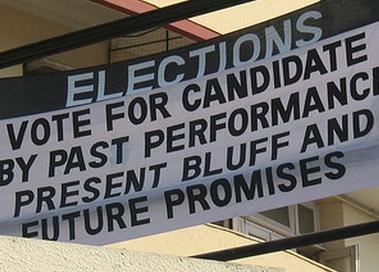
Election commentary in Marine Drive, Mumbai. Image by Dannybirchall and used under a Creative Commons License
Now that the 15th general elections are underway in India, the big question in every body’s mind is who is going to win? Will one party take it all or will there be no clear winner, which means a coalition government or a political patchwork quilt at the center?
To form the next government, either one party or a coalition of parties must prove they hold a majority in the Lok Sabha (Lower House) of the Indian Parliament. There are 543 seats to the Lok Sabha with thousands of candidates fighting to win the seat from literally over a thousand different political parties. Here is a snapshot of the number of seats in some of the key states. The Northern state of Uttar Pradesh has the largest number of seats: 80. Andhra Pradesh and Bihar are next with 42 and 40 seats, while Tamil Nadu has 39 seats, Gujarat has 26 seats, Orissa has 21 seats and Kerala has 20 seats.
The results of the elections are expected to be announced by May 16th and a new government will be formed by June 2nd, 2009. Prior to the elections it seemed that the race would be between the ruling Congress Party and it coalition and the Bharatiya Janata Party (BJP) that was ousted in the 2004 general elections. However, psephologists, analysts, observers and digital tea readers have been left scratching their heads with some recent developments. Oh, and let us not forget the astrologers.
Prior to the start of the election this was the broad thinking about the outcome: that either the Congress or the BJP will win the elections with support from various regional parties including the Third Front (yes, yes, I know the Third Front, esp the Communist elements have repeatedly said they will not go with Congress or BJP. But, never say never in politics and that is why the phrase politics makes strange bedfellows). The thinking was that the chances of a Third Front victory was a remote possibility with perhaps Mayawati as the candidate for Prime Minister. But, it seems that broad thinking on the election outcome will have to be tweaked. Analysts and various media reports say at this point it is anybody’s guess which party or parties are going to win and form a new coalition government. I guess one thing is certain: it will be a coalition government, but will be the mix of parties is still an unknown element.
Here are some reasons why analysts are revising or hedging their bets on the outcome of this general election in India.
The rise of regional parties: It appears that neither the Congress (and it allies) nor the BJP (and its allies) will win with a clear majority. There are over 1000 parties contesting the general elections in India, and a handful of these regional parties will play a key role in the formation of the next new government in early June. For the past 20 years the trend has been some sort of a coalition government at the center. The interesting trend to note is the the number of coalition partners required to form the government at the center has grown in number (increasing fragmentation) over the years and that clearly underscores the rise and importance of regional political parties.
Since the 1980s there has been a steady proliferation of regional parties in India, and they have come to play a key role at the Federal level. Along with the rise of the regional parties there was also devolvement of power from the center to the state governments. Mrs. Indira Gandhi was perhaps the last Prime Minister of India who wielded an iron fist when it came to center-state relationships. (Note: approx 40-45 percent of India’s current population was born after the brutal assassination of Mrs. Gandhi in 1984)
In the 2004 general elections in India there were no clear winners and the Congress hastily cobbled together an unwieldy coalition of different parties, including the Left party left by comrade Prakash Karat of Communist Party of India (Marxist) CPI (M).
And in this general elections the musical chairs and constantly shifting alliances between various regional parties means that many of the key regional parties are hedging their bets and want to play it by ear. Take the case of Orissa’s Chief Minister Navin Patnaik. According to The Wall Street Journal (WSJ):
“the Biju Janata Dal, broke off an 11-year partnership with the BJP, contesting the state’s 21 seats on its own for the first time since Mr. Patnaik created the party in 1998…(he) has signaled that while he’s open to other options, he won’t throw his support behind either Congress or the BJP.”
Or, take the case of Andhra Pradesh as WSJ points out, “where the Congress alliance with the local parties collapsed and it went to the polls alone in this Southern State that has 42 seats.”
The 2 states to watch out will be Gujarat and Uttar Pradesh (also Tamil Nadu, Andhra Pradesh and Karnataka) BJP’s Narendra Modi has been Gujarat’s Chief Minister since 2001 and has a fairly stronghold there because of the economic development of the state. BJP’s LK Advani is contesting from Gujarat. Voters generally vote with their pocket book and that just be the case in Gujarat in this election although there could be an erosion in BJP’s influence in the state. For instance, Mallika Sarabhai is running against LK Advani in Gujarat and her campaign style and the issues that is raising is vastly different from Modi/Advani platform. She is targeting the youth and women voters, two important voting blocs in this election.
The second state to watch out for is Uttar Pradesh, which is a battle ground state with all the major and regional parties duking it out. Mayawati of the Bahujan Samaj Party (BSP) made a triumphant return as the Chief Minister of Uttar Pradesh in 2007 by her skillful social and political engineering. Mayawati harbors strong ambitions to become the next Prime Minister of India and has flirted with the newly formed Third Front without having officially joined them.
BSP’s main opposition is Mulayam Singh’s Samajwadi Party that counts Bollywood actors Jaya Bachchan and Sanjay Dutt as its supporters. Singh is part of a loose conglomeration of regional political parties called The Fourth Front that includes the South Indian-actor turned politician Chiranjeevi from Andhra Pradesh. Then there is the Congress Party’s quest to regain the state that is spearheaded by Rahul Gandhi. Uttar Pradesh has been the traditional stomping ground for the Gandhi family starting with Allahabad and then Amethi. And finally there is the BJP, which has a fair degree of hold in the state but all that may have been eroded by the Varun Gandhi episode in Pilibhit.
In both Gujarat and Uttar Pradesh religion and caste play a strong role in the political arena.

Political Campaign 2.0 - Image by Flickr user baxiabhishek and used under a Creative Commons License
The rise of independents: In this year’s general elections there is an interesting new trend: the rise of the independent candidates who are fighting the elections. There is Meera Sanyal who is fighting from South Mumbai, Captain CK Gopinath from South Bangalore and Mallika Sarabhai from Gandhinagar in Gujarat. Both Sanyal and Capt Gopinath have a strong business background and are fighting the election on local issues. Sanyal is the head of ABN Amro, while Capt Gopinath was a co-founder of Deccan Airlines, a no-frills aviation company that was acquired by Vijay Mallaya’s Kingfisher. Both candidates are using a combination of old and new media to reach out to their voter base and appear to have succeeded in mobilizing their voter base. It will be interesting to see the outcome for both these elections. The more interesting thing to watch out for is whether more independent candidates will contest the election at a future date. Could it be that middle-class professionals, who have traditionally stayed away from politics might finally step in and start contesting the elections?
Youth and Women Voters: One of the fascinating thing about this general election in India is the various ways in which you slice and dice the numbers. There are over 714 million voters with about 25 percent of them under the age of 35 year. Roughly half the voters are women. The two blocs to watch out for is the youth and women voters. How will they vote? Will they vote based on issues or pocketbook? Do they have enduring party loyalties like some of the older voters might have? How these two groups vote might yield interesting result.
I don’t think many of the political leaders have a crystal clear idea of what might appeal to the younger generation, who grew up in a very different economic, political and social framework. This is a generation that has a strong sense of the culture of information technology. This will perhaps be the first election where the beginnings of what makes the next generation of voters tick emerges. India is one of the youngest countries in the world where 60 percent of the population is under the age of 35 years and they are the ones who are going to shape the future of the country.
There are lots of other variables that could influence the outcome of this general elections in India. Yes, while it seems that there may be no clear winner in this election it is also important to remember that there is almost a month left before the elections conclude. And a lot could happen in a month.
Who will win in this Indian election is the $64 billion question. Could comrade Prakash Karat become the next PM? Or, will it be LK Advani? Is it conceivable that Mayawati might become the default PM? Or, could Manmohan Singh make a comeback? Or, is there a political dark horse lurking in the background?
What is important is that India needs a stable and secular government at the center, especially given the recent developments in Pakistan, Sri Lanka and Afghanistan. Moving forward what India needs is a government that will focus on stability and economic growth and this is something that many savvy Indian voters are acutely aware of and hopefully each one of them realizes that their vote can make a difference.
This post is part of the Global Voices special coverage on Indian Elections 2009
Following the national and provincial elections on Wednesday in South Africa, grubstreet believes that there is only one story to be told: the election results and how the online media is responding.
In this post we are going to look at reactions from the web about the 2009 elections in South Africa starting with Hottest Gossip's facts about the election and the voting process:
TWO-TIER ELECTION
* Voters will be voting in national and provincial elections. Voting is under a proportional system where parties submit lists of candidates to fill 400 seats in the National Assembly, and for provincial parliaments in South Africa’s nine provinces.
* Parties will fill 200 of the National Assembly seats according to the national vote and another 200 seats in line with provincial support.
* Twenty-six parties will contest the election for the National Assembly and 11 parties will contest the ballot for the National Assembly and for all nine provincial legislatures.
* Parties have nominated 9,289 candidates for the national and provincial election, 61.6 percent of them male and 38.4 percent female.
2004 ELECTION RESULTS
* The ANC won 69.69 percent of the vote in the previous election held in 2004. The Democratic Alliance polled 12.37 percent of the vote, the Inkatha Freedom Party 6.97 percent and the United Democratic Movement 2.28 percent.
* Voter turnout in South African elections has been traditionally high. Turnout in 2004 was 76.73 percent.
VOTERS
* South Africa’s Independent Electoral Commission (IEC) says 23.18 million people are registered to vote.
* In the previous election in 2004, there were 20.67 million registered voters.
One thing you need to know from Grubstreet:
There’s only one story today: the election results and how the online media is responding. Everybody’s got the story that by 8.30am this morning, the ANC had 63.7% (2 078 352 votes) - with the largest total of votes coming from the Eastern Cape (503 730) — the DA 19.5% (636,637 votes) and Cope only 7.7% (251 200 votes).
Most of the parties’ Facebook pages are silent and the IEC’s website is not loading, possibly because of the the number of hits on it.
It’s hard to beat the immediacy of TV and radio on this one but News24 seems to have the best online package of the big online media houses, with a cool little map of SA showing the results as they come in (the Western Cape is going to the DA, the rest are sticking with the ANC). Click here to go there.
My favourite story of the past two days, however, goes to the Daily Dispatch, which ran a reader competition of people’s memories of the 1994 election. I actually got a lump in my thoa
Andrei Khrapavitski writes about the Belarusian LiveJournal blogosphere: “Do you know that the Belarusian population of Livejournal is bigger than that of a mid-sized regional town? Oh, yeah, there are MANY of us out there. And we do like to argue. Flipping through my Livejournal friends’ feed is so much akin to following news from the trenches.”
Svetlana Gladkova of Profy writes this about internet market in Russia: “… the most irritating trend here is how clones of various successful US projects turn into market leaders here while the original products ignore the market entirely and only enter it when it is already too late.”
The Uncataloged Museum reports on the opening of Michael Forster Rothbart's Chernobyl photo exhibit in Kyiv. Bint Battuta in Bahrain reviews Mohamed Makhzangi's Memories of a Meltdown; the book's author, an Egyptian, happened to be on a post-doctoral medical fellowship in the Soviet Union in 1986: “The first section of Memories of a Meltdown, the largest part of the book, consists of scenes that Makhzangi describes as ‘investigative literary reportage; stories that celebrate the reality of lived moments', as he watched and experienced the response to the disaster in Kiev.”
Pakistani blog Deadpan Thoughts posts an open letter to the President of Pakistan on the recent SWAT Taliban deal: “My Dear President, Kindly review your decision – think for the stability of Pakistan in the long run and revoke this deal which is bound to fail – show some courage and force our Army of the so-called Marshall Race to go into SWAT and stop these barbarians, Talibans who close girl’s schools, murder innocents and flog girls!”
India Climate Solution blog presents a new idea: “They have coined a word ‘Precycle' to promote simple lifestyle based on refusal to buy any time that you can do without. Why buy a packaged grocery and then throw away the packaging material while you could perhaps go in for unpacked fresh ones?”
The Voice of the Taino People Online says that a delegation of Caribbean Indigenous Peoples is speaking out on climate change at the Indigenous Peoples Global Summit.
GuyToons, a Guyanese cartoon blog, posts a series of funnies on the recently-concluded Summit of the Americas, while Trinbago Forever waits to see what benefits will be derived from the Summit and Mauvais Langue adds: “Instead of wasteful spending, use the money wisely and spend it to fight crime.”
Diaspora blogger Uncommon Sense reports that “perhaps the best known female political prisoner in Cuba” has been released.