Israel continues to stand by the victims and survivors of the terror in Mumbai. Awash with deep sympathies, the blogosphere's sentiments speak for themselves in mourning the loss of Rabbi Gavriel and Rivka Holtzberg, along with six other Israelis.
Reactions fell into three predominant camps with bloggers asking the questions:
Here are their responses.
The Jewish Response to Terrorism and Tragedy–

Rabbi Gavriel and Rivka Holtzberg (may their memories be a blessing). Photo sourced from Chabad.org
Rabbi Yonah of Jewlicious writes:
“I am heartbroken. The Jewish world weeps over the brutal murders of Jews, Indians, and others in Mumbai. News of the tragedy spread around the globe in minutes. We are all truly connected.
The response to the tragedy cannot be depression, but hard work. The way for us to avenge the blood of the murdered is to erect pillars of loving kindness and charity.”
Rav Eliyahu of A Dwelling Place for G-D in the Lower Worlds in an entry entitled “The Torah Response to Terrorism” echoes Rabbi Yonah, saying:
“The world is faced with terror all around it – now so, perhaps – more than ever. How should we react? What is the Torah response to terrorism?! …The response is a clear one. Continue to grow! Continue to do good. Do even more good!”
Leiv Esther joins the consensus on the Jewish response to tragedy:
“It is always hard to hear of Jews being hurt in any way. The Jewish response to any difficulty is to increase in our efforts to bring unity amongst Jews and goodness and kindness to the world.”
On an entry entitled “Muslims Mourn Mumbai Massacre,” Daniel Lubetsky points out that for the first time, Islamic nations have publicly condemned this terrorist act. In his Peaceworks blog, he posts:
“…a sample (by no means exhaustive) compilation of some of the Arab and Muslim nations and organizations across the world - from Saudi Arabia to the Arab League - who condemned the tragic and barbaric terrorist acts in Mumbai. Everyone can always do better, but the below can be shared whenever you are asked “Why are Muslims not condemning terrorism?”
Even blogs devoted to unrelated themes join in. Israeli Kitchen blogs:
“A candle for the victims of the Mumbai massacre. May G-d comfort their families and avenge their spilled blood.”

A Jewish man saying prayers in India. Photo sourced from Chabad.org
Why Jews Were Targeted
In a post analyzing why Jews (who were by coincidence also Israeli) were specifically targeted, Israellycool establishes a thesis that the terrorists' goal is to “establish a global Islamic Caliphate and impose Sharia law on societies currently based on Judeo-Christian principles.” He writes:
“It is no coincidence that the terrorists target Jews. Evil will always target Jews because we represent G-d in the world. It was true with the Nazis, and it is true with Islamic terrorism, the new Nazism. We have the task to be a light unto the nations, and even when though we may not always be completely successful, we have not done such a bad job. Especially when you look at the amazing work performed by a Jewish organization such as Chabad.”
In conclusion, he proposes a worldwide war on terrorism by ordinary people asking us to support Israel and all global democracies and promote the message that those who support terrorism will never able to live as free people, self-ruling people in their own state.
Treppenwitz's David Bogner concurs with Israellycool and expands on his argument that Jews were specifically hunted down and killed in the Mumbai massacres. Bogner explains:
“Mumbai is a city of over 18 million people, yet there are only about five thousand Jews living there. And of those, only a few dozen are identifiably Jewish outside of the synagogue.
Heck, the entire country of India - with a staggering population of over 1.1 billion people - has only about 15 thousand Jews! I'm not so good at math, but I think that if you try to express the Jewish population as a percentage of the overall Indian population, you're going to end up with a lot of zeros to the right of the decimal point.
So isn't it weird that nobody seems to be talking about how statistically odd it is that this Muslim terror group sought out and attacked an unremarkable home containing one of India's only identifiably orthodox Jewish families.
Apparently the breaking news from Mumbai has demonstrated anew that targeting Jews is not unusual… even when just finding Jews in India to attack is harder than finding Samoans in Iceland. ”
A Rediff News report quotes the doctors' reactions to the Jewish hostages murders in a story entitled, “Doctors Shocked at Hostages' Torture,” writing:
“Of all the bodies, the Israeli victims bore the maximum torture marks. It was clear that they were killed on the 26th itself. It was obvious that they were tied up and tortured before they were killed. It was so bad that I do not want to go over the details even in my head again,” he said.
Corroborating the doctors' claims about torture was the information that the Intelligence Bureau had about the terror plan. “During his interrogation, Ajmal Kamal said they were specifically asked to target the foreigners, especially the Israelis,” an IB source said.”
Jameel of The Muqata expresses his anger at Israel for their criticism of Indian security's slow response.
“Hypocrisy rules in Israel today as IDF [Israel Defense Forces] soldier Gilad Shalit remains a hostage in Gaza — a terrorist state created by Israel, and Israel's only stated way of freeing him, is the release of hundreds of murderous terrorists…
Yet my anger at Israel is displaced only by my sorrow and condolences for the families of the Jews murdered in Mumbai this past week.”
Indian Chabad House sign in Hebrew and English. Photo sourced from Chabad.org
Where Do We Go From Here?–
In our blackest moments, we ask ourselves, “Where do we go from here? What good can come of this?” There is no one answer– we must grieve and learn from it in our own ways– but Israeli bloggers have some suggestions.
Of like minds, both This is Israel and Jewlicious' CK post entries headed, “We Are All Chabad” and “We Are All Chabadniks,” commenting on how events such as these unite us as a worldwide Jewish family.
Yael of Aliyah! Step-By-Step reflects that for the first time since she was a child, the terror in Mumbai stirred her to fully celebrate Shabbat, the Jewish Sabbath:
“It just really felt to me like the right thing to do, the best way to honour their memory and all the other lives lost, criminally lost. In large part because by celebrating Shabbat as a Jew I was carrying on one of the very things the terrorists were fighting to wipe out. By celebrating Shabbat, which is symbolically in essence the celebration of the miracle of life and love and goodness and commitment for a better future, it is absolute defiance and rejection and maybe a tiny countering of the evil that so obviously exists in this world.”
And in “A Light In To the Darkness,” Israellycool reminds us that: “When the world was witness to the worst of humanity, it was also witness to the best,” citing the rescue of the Holtzberg's two-year old son by his Indian nanny, Sandra Samuel, who saved him at the last possible moment.
(Samuel returned with the family to Israel today, where the Israeli government is considering bestowing upon her the title of “Righteous Gentile,” one of the nation's highest awards that is given to those who risk their own lives to save Jewish ones.)

Indian-Israeli unity flag. Photo sourced from Facebook's Israel Condolence Book for the Terror Victims of India.
How We Can Help–
So how can we help? Chabad has established the Chabad of Mumbai Relief Fund to aid with the reconstruction of the Chabad center there and help support the Holtzberg's young child. The Jewish Agency of Israel will also help the families of those lost through the Fund for the Victims of Terror.
Let us remember the names of those who perished in the Chabad House last week and they shall represent our mourning for all the victims of Mumbai. May their memories serve as a blessing and a lesson to us all.
(Alternate spellings may be due to the transliteration of the names from Hebrew to English. Further names are pending release.)
Lastly, in a section of their website called, “What Can I Do?” Chabad urges us to honor the memories of those lost by committing to do mitzvot (good deeds) in their name. Over 950 have been pledged so far.
Further Reading–
This article is a continuation of “Israel: Sending Help and Sympathy to Mumbai” and is part of Global Voices Online's ongoing coverage of the Terror in Mumbai.


Picture courtesy of Take back the Tech
A campaign called Take Back the Tech aims to reclaim “Information and Communication Technologies (ICTs) to End Violence Against Women,” as well as continuing the battle against AIDS. This is one of the many initiatives across the globe that are encouraging women not to be afraid of technologies and through education [es] on how to use it to improve their lives. Today more than ever, it is important for women and girls to use technologies to improve their lives, especially in Central America.
Women in this region often make the headlines, but not for the reasons that one would like to read in the news. Instead, their news are about gender violence, extreme poverty, lack of opportunities, malnutrition, high mortality rates even gendercide. In spite of this, there are amazing women from all the region, who write primarily about technology and who try to make a difference in the lives of women.
Sweetsakura [es] not only is a software expert, she is also a supporter of free software, sharing information and tips on her blog about software, hardware and Ubuntu from El Salvador.
From Honduras, Librecaos [es]shares with her community the importance of software in local languages and celebrates that they finally have Ubuntu, an operative system, localized in Miskito, an indigenous language of Central America. She commemorated the recent International Day for the Elimination of Violence Against Women and recalled some experiences:
En esto días recuerdo más cuando empezaba a trabajar y me tocada hacer transcripciones de cassetes, todos eran talleres con mujeres hablando sobre sus experiencias, no podía evitar conmocionarme al oir como sus esposos las golpeaban, oirlas llorar cuando aseguraban que podían trabajar porque “No tenian permiso de su marido”, o peor escuchar como las usaban como si fueran muqueñas para sexo, y luego las dejaban.
During these days, I begin to recall the time when I started to work and when I had to transcribe cassettes of workshops where women spoke about their experiences, and I could not help but be moved when I heard how their husbands hit them, heard them cry when they were not able to work because “they did not have permission from her husband,” or worse hear how they were used as dolls for sex, and later they were left.
Vinculación [es] by Ivonne Aldana from Guatemala, is quite impressive. She discusses new inventions, new models and designs, ICT clusters and the importance of development scientists. La Piensa Libre [es], from Costa Rica writes with charm about technology, among other important issues, since it cannot be isolated from society, the environment and others.
Women literacy and improving education for girls can contribute to solve major problems by providing access to reproductive health information to prevent diseases, for example. Hopefully Central American women will increase in number of users of technology, producers and policy makers!

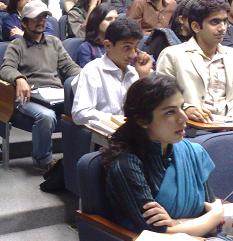
On November 23, 2008 more than 100 Pakistani bloggers gathered in Lahore in a meetup, the first of its kind in the city. The event was organized by LUMS IEEE Students Chapter (in collaboration with CIO Pakistan and Google Pakistan). The idea was to get the bloggers together to discuss about the blogging scene in Pakistan and promote this medium. The bloggers exchanged their views and shared success stories.

Initially this was planned to be an informal meeting for the twenty odd Lahore based bloggers. The only source of information on this meet up was an event posted at Facebook by Badar Khushnood (Country Consultant, Google). Quite unexpectedly more people showed interest and the number of probable attendees kept on increasing. The event organizers could succeed in collaborating with CIO Pakistan and RedBull, and the event turned into a mega bloggers meet where bloggers from across the country could participate.

Here's what Rabia Garib (editor CIO Pakistan) wrote about this phenomenon:
What started off as a really small 20 person event at LUMS has grown into something more than 100 attendees overnight… literally!
I also attended there as a blogger and am happy to cover this event for Global Voices. In my opinion the event was more like a seminar to encourage the beginners. Badar Khushnood explained the importance of blogging in today's world.
The key points discussed in the Meetup were:

You can find the details of the event here at my blog or at the official coverage page at CIO Pakistan website.
All photos by Farhan Janjua
African bloggers are highlighting water related issues, from the politics in South Africa that led to suspension of a water quality expert, new devices for collecting and cleaning water, to the 'scramble for fish' the East African lake region.

CC licenced photo by Julien Harneis on flickr.
We start with South Africa where the blog Urbansprout highlights the suspension Dr. Anthony Turton . Dr Turton is a researcher who was set to deliver a presentation at the conference “Science Real and Relevant” in Pretoria. He was barred from delivering the presentation, and later suspended by The Council for Scientific and Industrial Research (CSIR).
The blogger includes the presumed reason for his suspension as communicated by the CSIR, but also looks at the content of Dr. Turton's paper[pdf on environment.co.za], noting…
Taking a brief look at Dr Turton's paper, he argues that a lack of investment in science, engineering and technology (SET) since the early 1990's, the termination of important research projects and the shift to a contract driven income model has had a “catastrophic effect” on our national scientific capacity to deal with the technical challenges our water quality is facing.
There is also the question of academic freedom of scientists to present their findings. Urbansprout quotes a science journalist reacting to news of Dr. Turton's suspension.
Science journalist and former Journalism head of department of the University of Stellenbosch, Dr George Claassen asserted that the withdrawal of the presentation by the CSIR was an “absolute disgrace”. “This is a very serious encroachment on academic freedom and the right of scientists to announce their results, no matter how bad those results are for our view of things,” he commented. Claassen noted that academic and research freedom was protected under Section 16 of the constitution, which states that everyone has the right to freedom of expression, including academic freedom and freedom of scientific research.
Urbansprout provides the link for an online petition in support of Dr. Turton and concludes:
Turton's report highlighted that South Africa could be headed for a water supply and water quality crisis that could negatively impact on the economic growth and development of the country, as well as lead to social unrest. The findings conflicted starkly with recent government assurances that South Africa was not facing a water crisis similar to the one prevailing in the electricity-supply sector.
A previous post on Urbansprout gives more information about the water crisis in South Africa, which is characterized by sewage seeping from municipal treatment works to rivers. The water from the rivers feeds into the local tap water system.
A WaterMill is described on the BLDG blog as a device that “uses the electricity of about three light bulbs to condense moisture from the air and purify it into clean drinking water.” Rory of The Carbon Smart blog links to the BLDG post, and considers ‘micro devices' like the WaterMill, and whether this could be a source of clean drinking water for urban areas. He writes:
Discussion about the WaterMill — a small-scale dehumidifier that collects and cleans water from the air — leads to conjecture not only about how much of our drinking water could come from the air, but also about whether the urban microclimate could be significantly altered by installing thousands of these low-energy devices. Could we do away with a significant number of energy-sapping air conditioners by making our environment more comfortable through a combination of better building design, appropriate clothing, vegetating the landscape and reducing the ambient humidity with thousands of WaterMills?
In East Africa, the Kenyan blog Kenvironews highlights a piece by Namhla Matshanda of the African Security Analysis Programme. The piece looks at the conflict over Migingo island in Lake Victoria, which is claimed by both Uganda and Kenya. The piece warns:
The so-called ‘scramble for fish’ in Lake Victoria is turning out to be a source of conflict between nations bordering the lake and could potentially threaten regional stability. In the past month alone there have been several incidents around the lake that have heightened tensions between Uganda, Tanzania and Kenya. It is now apparent that the main source of these incidents is the lack of a clearly delimited and demarcated border between the three countries sharing Lake Victoria.
Since 2003, a number of Kenyan fishermen have been arrested and their boats and equipment confiscated by either Tanzanian or Ugandan authorities for “illegally crossing the common borders.” The latest incident happened when about 400 Kenyan fishermen were kicked out of Migingo island by Ugandan authorities. Migingo is claimed by both Uganda and Kenya. This incident has exacerbated the already strained relations between the two countries. The Kenyan fishermen have appealed to their political leaders to intervene, some even threatening violence.
Today is World Aids Day, and as a region with a relatively high number of people living with HIV/AIDS, you would think that bloggers Caribbean-wide would be very outspoken about the issue - but Jamaica is the only regional territory whose blogosphere - as a unit - seems to be adding its voice to the global discussion.
Stunner recognizes the occasion as “a day when the world pays even more attention to the ruthless killer. A killer disease that knows no bounds and respects no life, man, woman, father, mother, child, it kills indiscriminately”:
HIV/AIDS has made such an impact on our world's societies, since it first manifested itself and it still continues to claim many lives despite the desperate attempts of our leading researchers.
But even worse is that there are a lot of persons living with this infection and don't even know. This is also so true of our tiny island Jamaica and many of our neighboring Caribbean islands. Despite the many AIDS campaign and effort to curb the rate of infection, this malady continues to grow like an unstoppable monster.
On learning that “AIDS is the second leading cause of death for youths between the ages of 15 and 24″ in Jamaica, Iriegal's main concern is the young people. In another post, she writes:
I feel that more education needs to be given to the school children at an early age. Not talking about sex is not going to have it go away.
At the same time, she feels torn over her country's newly adopted National AIDS/HIV Workplace Policy:
The policy it seems will enable countries to screen employees for the virus as a means of preventing the spread of the disease. There is also support for many who have already contracted the disease.
I don't know how I feel about this. Is it and invasion of privacy? Aids still has so many bad stigmas to it. I can imagine and employer who finds out his employee has AIDS or HIV POSITIVE might use this as a means to have them fired or (with the current homophobic atmosphere on the island) place them in danger.
What happens when the investigations turn to the schools? I fear for the young children who already have the virus. Being ostracized is the least of their concerns.
Jamaica Salt is a tad more optimistic and believes that Jamaican celebrities have a key part to play in education and HIV/AIDS awareness:
It is being reported how there has been a thirty per cent decrease in the number of new AIDS cases being reported which is certainly good news and reflects the huge work that has gone into raising awareness.
I think that in particular the drive to include dancehall artists and promoters for music events in bringing home this message is a good idea. I went to a concert which which was giving away free condoms and had an information stall and there were artists there too talking on this issue. It is with getting these high profile and influential guys and girls to do something useful with their fame.
Meanwhile, Life, Unscripted, on the Rock has a few ideas about “what can you and I do to fight the far greater epidemic of fear, ignorance, and prejudice against HIV/AIDS, and persons living with the disease”, while Stunner reiterates the steps everyone can take to help protect themselves “from ever contracting the disease”, adding:
We are all affected by this disease in some way or the other as it is a worldwide disease and not limited to any nationality or ethnic group. So let us always protect ourselves from this killer disease. Also HIV/AIDS does not discriminate, so neither should we, and as such we should treat people living with this disease as a fellow human beings.
“World Aids Day, December 1″ - Thumbnail photo by by Sully Pixel, used under a Creative Commons license. Visit Sully's flickr photostream.
On world AIDS day, Malagasy bloggers reminded their readers that despite the progress made in the field of AIDS therapy and HIV prevention, one cannot afford to be complacent about preventing the disease. During his weekly address to the nation, the president of Madagascar Marc Ravalomanana reminded his fellow citizens that there is no development without health care and encouraged nonprofit organizations and faith-based associations to unite in the fight against HIV/AIDS. (more…)
Diligence informs readers of a new airline that connects Australia and East Timor.
“Heartiest congratulations to national security minister Martin Joseph on achieving this historic milestone: 500 murders in Trinidad and Tobago this year, as of yesterday”: Nicholas Laughlin thinks that Minister Joseph should be rewarded in a special way for his efforts.
Generation Y is thrilled about her win in the Best of Blogs contest, but says: “We still lack that which is the most coveted prize: the right to dialogue, dissent and to dye ourselves in the political colors of our choosing within our Island.”
Barbadian bloggers (Cheese-on-bread!, Barbados Photo Blog and The Bajan Reporter) give shout-outs to the land of their birth on the occasion of the island's 42nd anniversary of Independence.
“There is a lot to be said about the shocking series of events in Mumbai that finally–too late–drew to a bloody and violent close”: Jamaican blogger Annie Paul may eventually get around to articulating her own feelings about the attacks, but for now, she posts “a collage of quotes from a range of sources, all from the blogosphere…”; A Bermudian's View also weighs in.
Amila Bosnae writes about Refugees United, an international NGO which, she hopes, will help her and other refugees from all over the world get back in touch with lost family and friends.
On Bosnia and Herzegovina's Republic Day, Nov. 25, Amila Bosnae hosted a discussion on ethnicity and statehood.