In its third year, the Kolena Laila campaign took a different turn, reaching out to women with no access to the Internet and giving them a chance to speak to the world.
The annual event, spearheaded by Egyptian female bloggers, aims at giving women, identified as Laila, a chance to speak up and have their say.
In the words of the organizers of the We Are All Laila campaign, the event geared at posting podcasts, featuring interviews with women from all walks of life:
“The third year of Laila brings about a wider range of participation to comprise other categories that do not have access to the internet, and still maintain the track line of the first year’s theme. This year’s theme is to gather audio testimonies and stories of elderly women, for instance grandmothers, and women who do not use the internet, due to social or economic reasons. Such authentic audio testimonies give an air of vividness and are rather expressive; they also stand as an audio archive of the experiences of older generations of mothers and grandmothers for generations to come. However, Laila’s main track line is still there: to write or record Laila’s problems and issues and having the speaking up opportunity.”
Not many female bloggers really adhered to this year's main idea, except for Bent Masreya [Ar], who uploaded an interview with an Egyptian girl and discussed with her the obstacles females face in Egypt.
Another blogger, Ma3t [Ar], chose to honor her late grandma by writing about her struggle with education in Egypt from 1944 to 1948.
As for Manal, she hosted her mother who intrigued us with her experience with the new neighborhood she has recently moved to, and how she is being seen as a “foreigner” because she doesn't cover her hair. She writes:
Manal's mother then continues:
من المؤلم أن أعامل باعتبارى “الآخر” فى وطنى .. لمجرد أننى لا أريد أن |أكون سوى نفسى .. ولمجرد أننى لا أقبل أن أوضع فى القوالب التى تفرض على أجساد النساء .. أو لمجرد أن دينى مختلف. ”
The diversity of the posts across the Egyptian blogsphere added to the authenticity of the campaign and enforced it.
Noran el Shamly states clearly that she is no Laila:
Thankfully, the Laila Syndrome was not restricted to Egypt only and reached other Arab countries as well. Saudi Jeans hosted Maha El Faleh who urged women to stand out for themselves and claim their rights.
Al Faleh said:
“My message here is not to my country, and not to the government because their role should be in another chapter, but to the girls and women of my country: get off your high horse, look around you, speak up! Most of the oppression is not made by our country, it’s made by our silence, by our lack of interest, or sometimes because we are too oblivious to our surroundings. Look out for each other, help those who didn’t have the chance to speak, give them hope and guidance, we should stop expecting our county to make decisions for us”
Between supporters and opponents, here are the voices which took part in the Laila campaign.
LJ user drugoi's post with beautiful photos from Manhattan (RUS) is currently listed as the Russian blogosphere's most popular one at Yandex Blogs portal. There are over 400 comments so far to this item by one of the most popular and prolific Russian bloggers, and here's a quick, almost random selection of just a couple of them:
lamirka:
How cool! Too bad I don't have photos like these ones ( I looked at yours and recalled the feeling of [being inside] an anthill and of freedom at the same time. Thank you.
***
tutushka:
Thank you ) It suddenly occurred to me that I've never actually seen such truly positive pictures of Moscow and its residents. I wish I could.
***
andreybar:
Great shots. New York does differ so much from the rest of America.
***
rustex:
THANKS! A great series. Allowed me to feel the spirit of the City again. [New York] isn't that simple - it's not easy to get a sense of it. And you've managed to do it. […]
***
anywayblue:
New York used to be my only friend when I lived there for three years. I understood then why there were so many lonely people there - they could afford it - because they had this city.
LJ user drugoi also jotted down some notes (RUS) on the Russian-language blogosphere conference that he attended on Friday, Oct. 17, at Columbia University School of Journalism (for more information about the event - Russia Online: Mapping the Russian-Language Blogosphere and Participatory Internet - click on this link and and enter username: russiaonline and password: columbia):
[…] Spent the whole day yesterday at a conference organized by Columbia University and Harvard. Americans are studying the Russian blogosphere, among others, and have summoned the insiders capable of sharing their knowledge on the subject. Serezha Kuznetsov (aka [LJ user] skuzn) talked about “do you remember how it all began,” Ellen Rutten spoke about online literature research, mentioning the [”podonki language“] as one of [Runet]'s cultural phenomena, but overall, the discussion focused mainly on politics, of course. Of the things that were interesting, there was Floriana Fossato's report on the failures of Russian online political projects, and sociologist Olessia Koltsova recounted the story of the attempts to rescue the [European University at St. Petersburg]. The folks got excited, an interesting discussion took off, though I was a little surprised by the seriousness with which some people treat such civil actions, of the kind that were taking place when the [European University at St. Petersburg] got shut down. In Russia, such events are effective only when they are reinforced at the level of personal connections in the so-called “corridors of power.” If the dean hadn't been involved in “telephone” work then, no signature lists, no LJ communities or street actions would have helped. If they had been serious about shutting [the institution] down, they would have done it. […]

After questioning the reasons for a recent wave of prices rises in Cape Verde, bloggers were surprised last week at the news that the country is immune to the economic crisis into which the world beyond the archipelago is sinking. The claim was reportedly made by Cape Verdean Stock Market President, Veríssimo Pinto, in a debate at the national radio station. Now local bloggers want to know how this small nation can be crisis-proof and are asking: could God be Cape Verdean?
Retalhos [pt] listened to the debate about the international crisis hosted by the National Radio (RCV) in which the local Stock Exchange President claimed Cape Verde would not be affected by the worldwide crisis. She felt very confused towards the end and doubts what she heard:
Eu que não sou especialista quando comecei a pensar na crise disse logo: Demora… mas chegará!!!!…afinal nossos bancos são mais que ramificações dos bancos portugueses que estão inseridos no sistema financeiro europeu…que deu o berro… nossas empresas recorrem à bancos estrangeiros para financiamentos…vivemos “à custa” das remessas dos emigrantes (aperta-se o cinto na diáspora…aperta-se por aqui também). O mercado imobiliário está dependente dos investidores externos, na sua maioria europeus, o Turismo idem…A nossa moeda está ligada ao Euro…como acham que fiquei com a declaração? Sem dentes claro e muito confusa…
In the 40's, when the country was much smaller, the economic crisis which came after the war nearly wiped the Cape Verde out. Redy Wilson Lima [pt] reminds us of this piece of history and the news that the Cape Verdean economy is now so strong raised some questions for him:
A crise existe, os EUA, a Europa e a Ásia estão a tremer e muito, o mundo está globalizado e a nossa economia depende do turismo, da remessa dos imigrantes e dos investidores estrangeiros, para não falar da nossa banca que é 50% de portugueses. Alguêm me explica como podemos estar imunes? Ou será que Deus é mesmo cabo-verdiano?
A few days before the debate, Edy [pt] had already sensed a feeling of immunity and demanded that the authorities make public their plans for dealing with an eventual crisis:
Talvez seja oportuno o 1º Ministro e a Ministra das Finanças virem a praça informar o que o Governo pensa sobre essa crise e quais mecanismos económicos poderão ser apresentados como garantia para facer face a essa crise na nossa pequena economia.È também nessas horas que se deve demonstrar a face responsável da oposição preparada para governar.Todos,juntos ou cada um à sua maneira,deveriam e devem apresentar ideias.Antes que a crise financeira se tranforme em crise económica.
Whereas Tide [pt], at Pedrabika blog, says it seems that they live on another planet and wants to know when this tranquil situation will finish:
Enquanto nas grandes economias tá tudo entrando na espiral negativa que suga e derruba os grandes, nós continuamos a viver uma acalmia de pax financeira. Ninguém parou de investir/gastar, ninguem tirou dinheiro do banco para colocar debaixo do colchão, quem tem dinheiro rendendo não tá nem aí pra falência dos bancos americanos. Tudo continua na mesma. Me explica porque eu quero saber quanto tempo dura essa pax.
João Branco [pt] brings the news that as of today the prices for petrol are at last going down locally, with a 5% reduction at the pumps. He says it is still not enough, considering the actual price of crude oil worldwide:
Resta dizer que esta redução é ridícula, sabendo-se que o preço do petróleo já diminuiu para metade em relação ao mesmo período do ano transacto. Mas seja como for, agradecemos a esmola.
“SOS Cape Verde. Flag of Cape Verde, hoisted in a yacht of the ditch “The Solitaire du Figaro”, in its scale in the port of Vigo (Galicia, Spain). Curiously, the crew members of the yacht have hoisted the flag upside-down, which in vexilology is interpreted as a request of aid.” Photo and caption by Flickr user Contando Estrelas, used under a Creative Commons licence.


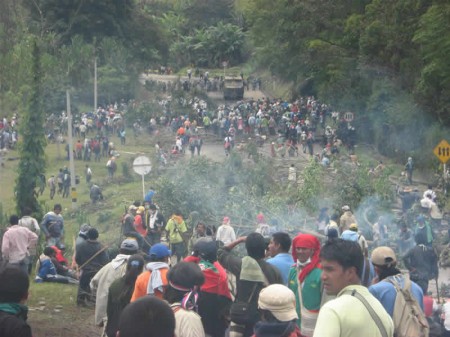
From Colombia, the indigenous groups in the Cauca department have made an international SOS to call attention on their plight. On their website, cric-colombia.org they explain how they have been protesting the human rights abuses they have been victim of, represented by the murder of one of their community leaders by hit men and the death threats on other regional and community leaders and spokespeople. They have requested a public audience with the Government Officials, and have been protesting since October 12, demanding the protection of their human rights and making the government live up to the promises of the signed treaties of the past. However, it is said that armed government forces, have shot live ammunition at the protesters, leaving 2 dead and more than 60 indigenous members injured. On this blog post on the indigenous community site they show pictures of the protest and the injuries some have sustained as well as the list of those injured up to October 14th. On October 15th, the armed forces opened fire once again on the protesters, killing one and leaving 39 injured. They have also blocked the roads and ambulances can't get in to help those who are hurt and needing assistance. (Links in Spanish unless otherwise noted)
la fuerza publica entró disparando con armas de largo alcance y ya hay 3 heridos mas de gravedad. la fuerza militar entro ya al territorio de dialogo y negociación.
Se solicita de manera urgente que organismos internacionales frenen esta violencia. tambien a los pueblos inigenas que refuercen el personal que esta siendo atacado.
We urgently request international organizations to stop this violence. Also for the indigenous communities to get more people to back those who have been attacked.
The indigenous community has been sending emails and posting on their website[es] updates on the situation.
The following video was posted last week by user nasacin, including cellphone and video camera images from the manifestations, clips showing shot indigenous community members, a soldier speaking about the differences between the Mob Control ESMAD and the armed forces, stating that the armed forces are to keep the peace, and the ESMAD is the one in charge of defusing violent situations. However, when asked who it is that is shooting with rifles, the soldier doesn't answer.
Blogger Alejandro Peláez last week wrote of how foreign media is reporting on the indigenous protests, but local media hadn't published anything at all:
Las noticias son hechos, y para escribir sobre hechos toca salir del escritorio, entrevistar personas, buscar en archivos, viajar al monte . Las masacres, por ejemplo, son hechos. Pero en este país los medios cubren este tipo de hechos con diez años de diferencia y ahí ya no son noticia, son historia. En este momento, como lo cuenta AdamIsacson (sí, un gringo sentando en Washington D.C.), hay serios disturbios en el Cauca y El Tiempo ni lo anota. Tal vez presenten una crónica completísima dentro de diez años. Chévere.
In Gacetilla Colombiana, a Digg style application for Colombian news, posters have been linking foreign news as an alternative for those who are under the “media blackout” on this event, in particular to a major foreign news chain's video [en] where a citizen media recording shows what could be an armed but hooded person dressed in green with a rifle going moving through the mob squad and shooting at the indigenous protesters as the members of the mob squad move to let him pass. In the blog “Lets Change the World”, Decio Machado posts the email chain sent out by the Indigenous groups, the means through which most Colombians have found out about the crisis. The Selvas.org blog also posts updates on the situation, how indigenous groups are all marching towards a main city called Cali and blocking the Panamerican Highway and other roads with 10 000 people, including cane pickers, farmers women and children.
In the national blogging award winner Tienen Huevo blog, they write outraged at the fact that at the same time there is an ethnocide going on in the streets of Colombia, trying to reach Cali, while a fashion and makeup expo is taking place, with people more concentrated on clothing and fashion shows than the indigenous situation.
The government has responded to the accusations of opening fire on the indigenous protesters by saying that they have orders not to shoot, so it must've been an inside job, someone infiltrated from the indigenous communities among the police in order to cause panic and bad feeling. Bacteria Opina blog has a caricature of the situation where two indigenous protesters comment that in spite of marching with “indigenous malice”, a phrase used to determine the ability to make do with whatever is doled out their way, the government is accusing them of being an “indigenous milicia”. The government has issued statements saying that these indigenous protests are infiltrated by guerrillas and are terrorist activities, statements the indigenous communities refute absolutely on their blog.
These other videos online on YouTube show the indigenous community's past struggles, this is the first of the multipart series:
Federico Ruiz posts a play-by-play ping-pong match style summary of events up until Saturday:
los indígenas decretan un paro, el gobierno lo declara ilegal, los indígenas se toman la panamericana, el gobierno manda a una fuerza especial antimotines de la policía para que desbloqueen las carreteras, más indígenas se suman a las movilizaciones, el procurador de la nación dice que va a los diálogos, el presidente dice que está muy ocupado para ir a resolver el problema, los de la policía intentan desbloquear la carretera a las malas, los indígenas dicen que no se van porque les tienen que arreglar sus problemas y cumplirles los compromisos que les habían hecho hace como 15 años y que están en ese link que es una “carta abierta al presidente”, entre tanto en las protestas matan a un indígena y hieren como a 10 según las informaciones de El Tiempo, pero que en realidad no son 10 sino 90 según lo dicen los indígenas, y los de la policía dicen que en la manifestación o en el paro hay infiltrados de la guerrilla, los indígenas dicen que no, y justo luego los indígenas descubren que si hay un infiltrado pero que justamente es policía y que tenía unos panfletos de las farc y unas armas para encochinar a los indígenas, y por si fuera poco, justo llega el defensor regional del pueblo, o sea un representante del gobierno, y dice que “la Fuerza Pública se ha excedido en el uso de las armas de fuego”.
EDITED to add:
The organization who sent in the recording of the hooded shooter among the mob squad team have uploaded it online with other images of the protests. The images of the shooter amongst the mob squad, shooting at protesters starts at 1:44. They also add images of President Uribe calling military leaders to ask about the murders of the protesters, to which the military replied it was a shrapnel wounds from a pipe bomb and wasn't a bullet injury.The indigenous people are also shown with segments of a handmade grenade full of metal pieces and ball bearings they claim the armed forces are using against them.
Morocco has an active and healthy blogosphere. Bloggers write in Arabic, French, English, Spanish, and Amazigh, covering a wide range of topics and issues. The one negative about the Moroccan “blogoma,” however, is that the majority of its adherents are clustered within major cities (Casablanca, Rabat, Fez) and abroad; little is blogged about the rural areas.
That's where the Peace Corps and Fulbright bloggers come in; as many are stationed in remote areas of Morocco, they are able to paint a picture of the other side of life in the country. And although they are not native to Morocco, they interact daily with Moroccan people and often blog about the issues facing their neighborhoods and villages.
Duncan Goes To Morocco is one such blogger. He recently discussed dental hygiene in his rural community, saying:
From my Western perspective, dental hygiene is a problem in my community. I wish that I could do a preliminary survey and find out how many people here brush their teeth, but I don’t think that is an appropriate thing to do. If I had to estimate, I would say that in my entire 450-person community, maybe 5 people use toothbrushes on a regular basis. But there’s really no way for me to know and it could be as low as 0. It’s not just my community; I’d say that the idea of dental hygiene is one that is fairly new in Morocco.
He then explains how he is addressing this problem:
In the schools I’ve been talking to the kids about brushing their teeth. Basically I tell them that if they don’t brush their teeth, their teeth will rot and fall out, just like the older people in my community. I try to be very blunt about it. I brought in a hard-boiled egg soaked in Coke, which made it turn brown, and then had the kids use toothbrushes to clean the egg. I also brought in a model clay mouth for the kids to practice brushing teeth on. (Side note, hands-on education is not apart of the teaching pedagogy here; it’s all about rote memorization.) Since doing the education, I’ve been coming into the school on a regular basis during their recess and having all the kids brush their teeth in front of me. It’s pretty funny to watch 30 kids slobber spit and toothpaste all over themselves and realize that this is my job. I think that an activity like teeth brushing is something that, if you’re a child, you need to practice doing over and over and over again until it becomes a habit.
He also explains his feelings on the subject, and shares a bit of his thoughts on being a health volunteer with the Peace Corps:
Balancing these two conflicting feelings, I guess I want to believe that people will change their behavior. There are many things working against me, but if I concentrate on this issue, some people will come around. Even if people don’t immediately change their behavior, introducing the idea of dental hygiene is the first step towards ultimately changing things. Change might not come immediately, but maybe I’m laying the foundation for behavior change in the next generation – at least that’s what I tell myself. Some volunteers are very negative about changing Moroccans behavior and I think they let that negativity limit what they try to do. I came here to do health education and I’m going to try and do it. Plus it gives me something to do and some feeling of efficacy.
Emily and Jon in Morocco is the blog of a married couple who are both new Peace Corps volunteers. In a recent post, they share their thoughts on a few cultural differences they've encountered. An example:
Another differing topic is the concept of space. In a typical rural Moroccan household, there are no separate bedrooms. There is generally a sitting room (living room), a salon (a room for hosting guests, which is generally bigger than the sitting room), a kitchen, and a sleeping room (where any combination of family members may choose to sleep). Sometimes, family members sleep in the sitting room. The bathroom may or may not be inside the house. Sometimes, it is an attached structure with its own entry. Families generally store their clothes together and designate a room for changing clothes. Furthermore, there isn't a whole lot of “stuff” that family members own. There aren't piles upon piles of toys for children. There is no clutter that takes up all the room in the house. It just doesn't exist. The family ties are more important than the individual; there is less emphasis placed on individualism and more emphasis placed on collectivism. Living with a Moroccan family has helped us understand how materialistic, individualistic, and direct our own culture is. Not necessarily bad; just different. Its interesting to consider that we don't really know who we are unless we step outside and look around for differences of which to compare ourselves
For more information on Peace Corps bloggers in Morocco, this site has a list of bloggers. Global Voices has also covered the Peace Corps Morocco blogosphere previously.
It seems that the financial crisis rocking the US markets is hurting people everywhere - even the daily decisions of laymen and people who do not own businesses.
Zeinobia wrote here about how some people have decided to withdraw their money from foreign banks here in Egypt, and invest this money in buying gold.
She explained:
The ministers and officials are appearing here and there to calm the people down saying that our economy is fine and that we got a great opportunity to attract the Gulf capital money escaping from Wall Street !!Anyhow let the officials say whatever they want ,it seems that the implications of the Bailout and the nationalization of banks across the U.S and the Europe have their impact here in Egypt. I read news and I also heard from relatives and people who work in Egyptian banks that Egyptian clients are withdrawing their money from the foreign banks especially Citibank. The problem that they do not deposit in any other national or Arab bank ,they take the money and buy Gold.
Egyptian people are used to buy Gold whenever there is an economic crisis .It is a custom, gold is more secure through time ,it does not lose its value so rapidly like money.
I think we need financial and economic experts to study such a phenomenon, and its effect on banks, and the country's economy as a whole.
The Electoral Commission in Ghana is accused of disqualifying a presidential candidate: “[H]aving failed to successfully filed his nomination forms to contest the December elections, Mr. Dan Lartey, flag-bearer of the Great Consolidated Popular Party (GCPP), is nursing a plan to drag Ghana's electoral body to court for “deliberately” refusing his nomination.”
Loy asks, “Isn't it time for a Wb 2.0 aggregator for Nigeria”: I think I won’t be wrong to say that the only web 2.0 technology that Nigeria has ever brought to the web space to date is Sturvs, Nigeria’s version of Digg. Thanks to sturvs, we now have a voice on the web and can share our stuffs, music & video contents all around the web.
Jordanian Roba Al Assi overheard this conversation at her office - about the rise and fall of Rainbow Street.
From Jordan, Mai Al Shareef [Ar] argues that black is the best colour for the Islamic veil worn by women.
On the power of Facebook, Loza, from Amman, Jordan, shares this video.