As the economic crisis continue to worsen, both US presidential candidates, European leaders and heads of international organizations predict that international aid will have to be reduced. Developing countries like Madagascar which are still relying heavily on international aid fear that such reduction will severely hinder the progress made in social development and reduction of extreme poverty.
So will the economic crisis affect Madagascar and how ? Madagascan explains (fr) :
En conclusion, oui, Madagascar sera inévitablement impactée par la crise internationale actuelle. D'une part parce qu'il est prévisible que les Etats resserrent leurs aides aux pays pauvres, d'autre part parce que les grands projets actuels dans le pays auront probablement des problèmes de capacité d'investissement très rapidement, et enfin parce qu'une source importante de richesse du pays, le tourisme, sera fatalement affecté
Randy do it, a national Malagasy journalist and blogger, provides a “how the marketplace works for beginners” by using an analogy that involves a fictional rural market place trading monkeys (fr):
Dès lors qu’il a le dos tourné, son assistant rassemble les villageois et leur indique les cages, avec les milliers de singes que leur a achetés son patron “Si vous le voulez, leur dit-il, moi, je vous cède ces singes à 35 dollars l’unité. Ainsi, lorsque mon patron reviendra, vous pourrez les lui revendre à 50 dollars. » Les villageois, aveuglés par la perspective de cet enrichissement facile, sortent toutes leurs économies, vendent leurs biens pour racheter les singes. Le magot encaissé, l’assistant disparaît dans la nuit. On ne le verra plus. Ni lui, ni son patron. Dans le village, rien que des singes, courant dans tous les sens. Et Nadim Kalife de conclure son histoire par un édifiant : « Bienvenue dans le monde de la Bourse ! » Eh, oui ! Il y a quelque chose d’aventureux à vendre un singe à dix dollars, puis à le racheter à 35 dollars, en espérant le vendre une seconde fois à 50 dollars.
Finally, Moonlight girl, new blogger from Antanarivo, tells a sobering story of the consequence of extreme poverty and how it affect health care for many in Madagascar. She recalls a recent encounter in a bus in Antananarivo:
She started to cry and tell me that she just gave birth 2 days ago at a famous public hospital. She was poor and didn’t have the money to buy medicine for the baby who suddenly became sick. At this hospital, if you can’t buy the medicines you need, it means you’re waiting for death. They don’t care about the person’s situation. So her baby died, and this woman didn’t have money to take him back home. She lived at Ambatofotsy , which is very far from town. Taking a taxi to those places , will cost a fortune. Now, she’s going to her sister’s house at Ambohipo; to take her child. I was heartbroken and terrified at the same time, thinking about this woman carrying her dead baby around. The driver’s aid, was very angry and started to yell at the woman, and forced her out the bus. He said, that she did something very taboo, about letting a dead be among the living. The poor woman just left the bus, not wanting to cause anymore trouble.


“Looking Towards Pte. Michel” - Photo by Steve Mc, used with permission. Visit Steve's flickr photostream.
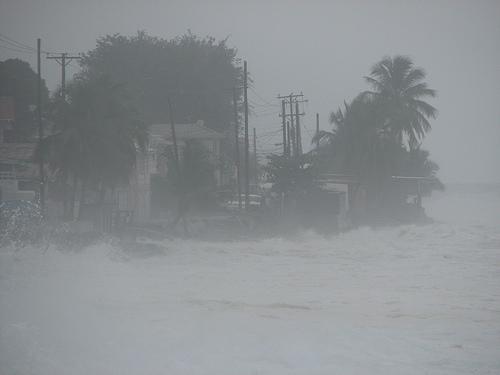
The Caribbean is officially in the midst of its wet season, but many regional territories are battling more than their fair share of sogginess, thanks to the torrential rains that accompanied Tropical Storm Omar - a storm that was soon upgraded to a Category 3 Hurricane as it forged a path through the northern Caribbean.
Cuaderno Latinoamericano said that the region was being “pounded”:
Shortly before approaching the islands as a Category 3 hurricane, Omar's maximum sustained winds had increased to 125 mph, but slowed a bit to 115 mph after moving rapidly away from the islands.

“Waves break on the Roseau Bayfront” - Photo by Steve Mc, used with permission. Visit Steve's flickr photostream.
Blogging form the US Virgin Islands, News of St. John was very concerned about the approaching weather system, but soon reported that things looked a-okay after it had passed:
Beautiful weather has returned to the Virgin islands, to judge by a report this morning filed by a Weather Channel meteorologist from Puerto Rico. He said PR got .25 inches of rain, St. Thomas about 2 1/2 and St Croix nearly 5, suggesting St John got something like 3 or 4.
Despite the minimal disruption to the Virgin Islands, Omar was being taken very seriously, causing several flights to be canceled, according to Discover TnT Blog:
LIAT has advised the suspension of several flights as a result of anticipated severe weather conditions generated by Hurrican Omar. Omar is the 15th hurricane formed in the Atlantic during this year's hurricane season, which is supposed to end on Novemeber 30.
Storm alerts have been posted for the islands of Guadeloupe, St Maarten, Saba, St Eustatius and St Barthelemy. Luckily, storm-battered Haiti, Cuba and Jamaica have been spared.
Meanwhile, Omar's effects were being felt in St. Vincent and the Grenadines. Abeni wrote - almost incredulously - about the storm's impact:
It didn't rain last night-well not in a manner that was noticeable. Yet, this morning we awoke to the news that the sea had wreaked havoc in coastal areas and town. Would you believe we got surges from Omar? On my way into Kingstown, I looked towards the harbour and the Grenadines and saw some angry looking waves and realised that peacefulness had not yet returned.
She continued:
It underlies how really vulnerable we are to natural disasters. In the twinkling of an eye everything can literally fall down around us and we are powerless to stop it. Mother Nature, when not showing her softer side can be one deadly woman that we would be well advised to steer far from. I guess the events of last night are a reminder that we really should shed our lackadaiscal attitudes to disaster preparedeness.

“Tail End of Hurricane Omar, Bay Front Dominica” - Photo by TropicallyTied, used with permission. Visit her flickr photostream.
Dominica Weekly said that the “nature isle” also experienced a taste of Omar:
Within the last 16 hours there have been numerous reports of coastal damages to the west coast villages (i.e. Pointe Michel, Newtown, Dublanc, Portsmouth, etc.) of Dominica due to high sea swells…

“Pte. Michel Road after Hurricane Omar” - Photo by Steve Mc, used with permission. Visit his flickr photostream.
Miraculously, though, Omar seemed to have wreaked much less havoc than his 2008 Hurricane Season predecessors. His bark was worse than his bite - soon after threatening the north-eastern Caribbean, Omar weakened back to the level of a Tropical Storm.


With the abolition of custody and repatriation (C&R) system in 2003, it seems the Chinese petitioners no longer have to worry about being detained as illegal residents when they leave for a strange city to petition a higher governmental institution. However, according to blogger Xu Zhiyong, a young professor of law and strong advocate for human rights, those supplicants are actually still being intercepted by the local officials from the way to the State Bureau for Letters and Calls, the Supreme People’s Court or other departments, and forcedly taken to some makeshift house of detention, being lock up without any legal process. As the places which confined the petitioners are always hidden among the ordinary buildings, people call them “Black Jails”.
In cooperation with citizen reporter Zhou Shuguang (Zola) and other two journalists Chen Er (Doubleaf) and Guo Jiannong, Xu Zhiyong, who firstly blogged Beijing’s black jails in the end of September, went to visit one of the unlawful prisons again on Monday, attacked by a group of thugs who were allegedly hired by the authorities.

Xu introduced the background of the operation in his blog:
昨天接到一个短信,“我是河南马喜荣现在关在北京市虎坊路青年宾馆后院黑监狱里你能解救这里的二十多个人吗紧急求救”。我因为当时在上课,这两天又特别忙,就答应今天去。上午十一点多最后一次发短信确认她还在里面,决定下午四点过去。
和周曙光约好,四点在青年宾馆见面,他还约了另外两个媒体的朋友。四点一刻,我们三个来到黑监狱门口,周曙光在远处拍摄。马喜荣来到窗口要求出来,看守不让出,一边和当地驻京办联系。我们在窗外和她聊天,她说是走在王府井大街上被警察盘问,查出了上访材料被带到派出所,然后被关押到这里。越来越多的上访者聚集到窗前,这时马喜荣被看守推到里面,听到她对看守大声说,我是一个合法公民,你是什么身份,凭什么阻拦我在这里?
……
Doubleaf, a well-known blogger in China, from his unique angle promptly blogged the situation at that time :

许志永和郭建龙在黑监狱门口

黑监狱所在巷子
……
黑监狱实际上是一所名叫“温馨青年宾馆”的旅社,在天坛西面、陶然亭附近太平街一条很逼仄的巷子内,往来的人很少,只能容一辆车经过的地上积了许多落叶。从外面看,这座破旧的建筑和黑监狱没什么关系,但这里却关押了20多名被非法拘禁的访民,都是河南人。这座宾馆实际也是河南信访办租来,专门关押访民的地方。到了黑监狱门口后,郭建龙和许志永二人负责与里面沟通,我在边上察看动静。经过一番口舌后,我们想要的人终于出来,与我们隔着一扇防盗门进行了简短的对话。我们今天要的人是一名五十多岁的妇女,据说还没有来得及上访就被关了进来。
后来,又有一位自称是家属、实际是截访人员的男子来到黑监狱门口敲门,但由于我们在的缘故,里面的人并没有立即给他开门。我们又与此人聊了一会,得知了一些情况。
该男子等了20多分钟才进去,我们后来又与要找的人进行了简单的对话,我不停听到她说“不就是说几句话嘛”,可以推断当时里面的人极力阻止我们的对话。
在此过程中,巷子的拐弯处、以及另外一头有3、4个彪形大汉远远张望,许志永说这就是黑监狱的打手。其中一名打手还抱着孩子经过。听zuola说,该打手称要“抱着孩子过来踹他们几脚”。然后,我们又与一名隔窗的女访民说了几句话,她自称是“自愿”到这里的。
就这样过了一个多小时,大概5点20左右,一辆牌号为京MG8490的面包车开进巷子,下来3、4个大汉,骂骂咧咧的揪住郭建龙问是干嘛的。郭说接人,一名大汉很不耐烦的说“接谁接谁”。没几句话之后,几名大汉开始动手打人,我们赶紧叫几十米外的zuola跑。这时,开始监视我们的打手也陆续过来了,一共在6、7人左右。开始在巷子另外一头监视我们的操北京口音的胖子打许志永最狠,一边打还 一边骂脏话,说“你丫不是律师嘛”。也许是因为刚来的时候主要是郭建龙和许志永与他们沟通、我基本不说话的缘故,他们没有打我,而我也有点吓蒙了,既没有逃跑,也没有动手反击,做了可耻的看客,连暴喝一声“住手”的勇气也没有。
这帮打手边打边骂,还很嚣张的说,边上就是派出所,去报警啊。大约打了5分钟后,他们终于住手了,但我们并没有离开。这个时候,一名打手指着我说,他也是一起的。但是边上的几位打手并没有动手打我。
整个过程中,许志永和郭建龙没有进行任何的还手。
坚持了一会,大约17:45左右, 我们要找的人终于在她家乡信访办官员的陪同下出来了。我赶紧和许志永、郭建龙一起往外走。在走到巷子拐弯处的时候,另外一名打人最狠的打手又冲出来,叫嚷着要开车把许志永撞死。许志永站在路中没动,我于是赶紧拉起他说人已经救出来了,我们快走吧。许志永对这帮打手说:我们还会再来的。
……
Zola gave an outline of the whole thing and had more materials in his blog:
……
10月13号,我中午在twitter上发消息,找人一起去看黑监狱,doubleaf正好休假,21世纪经济报道的郭建龙正好也有空,于是约了四点在青年宾馆见面。见面后分工是,我在路口把风并记录,他们三个人去门口要人。我于是在下图的B点的北京市六十二中学的门口远远地看着A点,他们三个人在A点交涉要人。

从http://log.zuo.la/ 可以看到我的零碎记录,我们约是四点半开始,五点半结束。一个小时里,黑监狱的看守没有采取行动,到五点二十左右,京M G8790 的小面包车进来,下来四五个人,开始打人。打人的录音在这里,是郭建龙和许志永以挨打为代价换来的现场录音。欢迎下载收听.
……
下图是当时打人的情况,我只拍到几秒种,隔得太远,不清晰。

下图是刚到黑监狱的时候,郭建龙和陈二在打电话,许志永在敲门要人。

我自拍,我的西面是六十二中学的校门,北面是许志永他们在要人,东面是青年宾馆的侧门,有几个打手在那里,我身后是南面,也有两个人站在那里,身份不明。

下图是朝东面拍的,三个男人里有一个是抱了小孩的,三个男人是打手,骑单车买来啤酒,喝酒后打人的那个没拍到,那个人是最凶的,还掐许志永的脖子,把许志永的衬衫钮扣都揪掉一个。

下图的黑荚克曾对棕荚克说:“过去,踹上两脚”

下面是10月5号去黑监狱的照片,从这次打人来看,后面的京M G8790 是黑监狱的车.

Besides the four men’s admirable courage and omni-directional blogging afterwards, another stunning knockout of the black jail operation is Doubleaf and Zola’s live report on the event by Twitter, which, as Isaac Mao commented, “has showed the social media’s potential routes of transmission and power.”
Podcast: Play in new window | Download

October 15 marked the annual event of Blog Action Day. On this date, bloggers from all around the world pledge to publish a blog post aboug a particular topic. This year the chosen subject is poverty. This campaign hopes “to change the conversation that day day, to raise awareness, start a global discussion and add momentum to an important cause.”
Here is part two of a collection of Latin American bloggers who participated in the campaign (see part one here):
Brazil
The blogger, Sérgio Coutinho of Mundo Em Movimentos [pt] is a university teacher and says the following that poverty is not just related to money:
Combater a pobreza não significa, como tem sido feito pelo capitalismo, combater os próprios pobres, achatando suas rendas e dignidades, mas combater o pensamento miserável, escravo do momento em que se vive sem perspectivas de transformação do próprio mundo.
Reducing poverty does not mean, as Capitalism has done, fighting the poor people themselves, flattening their income and dignity, but to fight against the miserable thought, slave of the moment in which we live with no prospect of transforming the world itself.
Venezuela
Ciberescrituras [es] finds the statistics associated with poverty in South America very troubling:
Es absolutamente insultante que en nuestros países de America del Sur se esté hablando aún de 80% de pobreza crítica y es que no hablamos solamente de aquellos que se mueren de hambre segundo a segundo sino de aquellos que no pueden ir a la escuela, que son explotados y humillados a veces en condiciones premodernas, casi medievales en los cinturones de miserias de nuestras ciudades capitales.
It is absolutely insulting that in our South American countries that there is talk of 80% of critical poverty and that we are not only talking about those that die from hunger second to second, but those that cannot go to school, those that are sometimes exploited and humiliated in prehistoric, almost medieval conditions in the areas of misery of our capital cities.
Argentina
At Artepolítica [es], Charlie Boyle compiles a list of Argentine bloggers that have written about Blog Action Day. Vientos del Cine [es] is normally a blog that discusses cinema and for Blog Action Day, they keep with the subject, but write about films that contain scenes of poverty. Sine Metu of BlogBis [es] also reflects on the audience of this campaign, “Very few poor people will read this post. Probably none.”
Ecuador
María Cristina Martínez from Santo Domingo de los Tsáchilas and who blogs at City @ Ciudad [es] writes:
Empecemos por poner nuestras profesiones o conocimientos al servicio de los demás. Miremos en nuestro interior y actuemos con amor ante las necesidades de las personas que nos rodean, y recordemos que por mínima que sea la acción que realicemos ésta hace el mundo diferente.
Let's start by putting our professions and our knowledge for the service of others. Let's look inward and act with love towards the needs of those around us and remember that every little action makes the world a different place.
Nicaragua
To tackle the issue of poverty, German Macias of Estación Macias [es] writes that we must “stop looking in the past, and we must look forward to find new ways of the future.”
Guatemala
Nathan aka The Data Geek [es] writes about the problem of poverty and its related problem of crime that takes place in Guatemala, and thinks he has a possible solution:
… crear fuentes de trabajo, capacitar a las para que desempeñen un trabajo, y a los menores de edad, brindarles de educación necesaria para superarse en la vida, pero se que esto no se logra de la noche a la mañana, para que esto funcione, depende de nosotros, no ser discriminadores, sino ayudar a las personas, podemos darles las cosas que ya no usamos, como zapatos, ropa, cobijas y cuando podamos darles comida.
… create jobs, train those to do a job, and for youth, provide the necessary education so that they can get ahead in life, but this does not happen overnight, for that to work, it depends on us, to not discriminate, but to help others, we can give them things that we no longer use like shoes, clothes, blankets, and when we can, food.
Special thanks to Luis Carlos Díaz and Paula Góes for providing links for this article.

As part of the global Software Freedom Day, Free Software Macedonia for the third time has organized an event in the center of Skopje. On Oct. 4, they distributed leaflets and disks with Ubuntu Linux, which were prepared specifically for this occasion and included free software applications for other operating systems as well as a movie on the Swedish piracy culture, “Steal This Film.”

The event started on the square, and included a group of artists who collaborated on a painting dedicated and inspired by this day. On the blog of Free Software Macedonia, the members wrote (MKD):
The canvas attracted the attention of the people on the square, although there were more events happening at the same time. The artist started working immediately, and soon there was “free software” on the canvas.

They were satisfied with the response of the people and the event (MKD):
We gave information to a lot of people, and some of them even stopped and asked questions. There were people who came with concrete questions, but most people had general interest in the event and the activities.
Overall, the event was better than expected. Probably some of the people, who really got interested in free software culture, will come sometimes to “Share Knowledge” or “Share Movie”, where we can make deeper contact.
Free Software Macedonia every week organizes events like “Share Knowledge,” where they are sharing their knowledge, experiment and discuss with the people interested in free software, and “Share Movie,” where they are showing interesting presentations, open content films and YouTube playlists. At these events anyone is welcome and can attend free of charge.
Photos credit: Free Software Macedonia, used under Creative Commons license
Both Thailand and Cambodia are claiming the historic Preah Vihear temple and the four square kilometers of territory near the shrine. There was a border clash in the area last Wednesday which killed two Cambodia soldiers and wounded seven Thai soldiers. The two countries are accusing each other of starting the fight.
The tension has not yet subsided since troop buildups are continuing. But there were good updates as well. Both sides are talking now and they initially agreed to conduct joint patrols in the area.
The Mirror provides a narrative of last Wednesday’s fighting. Global Voices author Tharum writes a backgrounder on the dispute. Andy Brouwer uploads an article by Milton Osborne. The author reviews the historical claims of the two countries on the territory. The author also highlights the political turmoil in Thailand as one of the likely factors which caused the escalation of the crisis a few months ago. The author adds:
“It represents yet another instance of a readiness of some Thais, whether politicians or ordinary citizens, to adopt and advance positions that seek to undermine what they see as irrelevant and irksome Cambodian interests.”
Sadchu believes Thailand is playing a “dangerous game”:
“What is Thailand doing? Is it trying to show off its military muscle? Thailand is getting close to the point of splitting the nation into two because of bad nationalism. With existing wound inside and being as a bad neighbor with all the countries around, Thailand is engaging herself with a dangerous game.”
Lything reminds both Thailand and Camdoia that “the rest of the world is watching”:
“Violence against people of another country to show that yours is superior to theirs is like the dumbest way to show patriotism. And by violence, I don't just mean wars; I meant any form of violence, including verbal. When people fight, they forget that the rest of the world is watching.”
someone – remaerd insists the fighting will not solve anything:
“I don’t want soldiers and people die, because it is the game of other people that they play with lives of innocent people. It is so sad historic event. The fighting, though continue till next year, will solve none of the issue of borders. People will die, soldiers will die, children will lose their father, wife will lose her husband, trade is down…”
Cambodia Calling observes that the border clash reminded residents of Khmer fighting in 1975:
“My Khmer landlord told me some Khmers have left Siem Reap to head south to the capital Phnom Penh and people have asked her, “Why are you still in Siem Reap, why aren't you running away?
“Obviously the war is still fresh in the minds of some Khmers and fighting anywhere in the country spooks them. They must be thinking of those days in 1975 when the Khmer Rouge won control of the countryside and instead of running away, people stayed in their homes in Phnom Penh, to disastrous consequences.”
The Mirror emphasizes that peace should be the only choice:
“To use force instead of negotiations on the current issue of disputed land – negotiations which have already been scheduled through mutual agreement – would also contradict international norms of settling bilateral issues through peaceful means, as the member countries of the United Nations have committed themselves. And to use force when negotiation is still possible ignores the bitter lessons of the many years of war in Cambodia’s history. If the choice is war or peace, the choice can only be peace.”
Bloggers are mourning the death of Cambodian soldiers. Preahchan is also sad:
“My deepest condolences for the Cambodian soldiers who died defending our Cambodia’s sovereignty from Thai invasion and aggression. May you rest in peace, and you will be always remembered. May God bless our brave soldiers, and may they win over the greedy invader. I condemn the Siem nation for their shameless invasion of my beloved country.”
My Khmerican Corner uploads an article by Sovatha Ann. The author believes the Preah Vihear territory is a site of shame for Thais rather than one of pride. Sacrava Toons provides us with political cartoons about the controversy.
(The second part of this article will feature the views of Thai bloggers).
Channel 19 blog provides some insight into the recent partial transport strike in Mumbai: “This event not only highlights the issues of autorickshaw drivers and taxi drivers in India’s most populated city, but it also sheds some light upon the disparities of socio-economic class, gender and infrastructure.”
Biseda, an Iranian blogger, has published a couple of photos of a 1,500m (4,920ft) long sandwich made of ostrich meat.The crowd started attacking the sandwich before any of the three Guinness representatives present had the chance to confirm its length. The blogger says these people are hungry and do not care about Guinness.
Iranian Futsal team failed to book a place in semi-final in Fustal World Cup but many Iranians praise its performance.Ehsan says [fa] Iranian authorities should reward this team generously.
Self proclaimed a storyteller (from an imageseller world), the Paris based Brazilian artist and blogger at Spam for Free makes his bookmark spam available for download. Instructions: “download and print this pdf file in two A4 paper size; stick with glue in recto-verso the both pages; cut each one and spread it in your preferred library (Please choose authors commonly used by Ph.D. students)”
Yagoob asks if bloggers in Bahrain are a dying species.