(This is article is crossposted on Voices without Votes)
Excitement is growing in a sleepy fishing town on the coast of the Japan Sea. The city of Obama, whose name means “little beach” in Japanese, is receiving unusual attention for its coincidental resemblance to the name of a certain US presidential candidate.
Obama merchandise, from T-shirts to manju to chopsticks with Obama's face printed on them, is sold at local shops and posters are put up at every corner of the city. On Super Tuesday, a volunteer group that supports Obama organized a “public viewing” event, attended by about 300 residents wearing their Obama T-shirts and headbands. Adding to the excitement, the mayor of Obama received a letter from the Senator expressing appreciation for their support.
A blogger [Ja] shares the city's excitement:
It is quite a surprise that a letter addressed to the city arrived from [Senator] Obama.
Even though it was for the support that came from a place that has no influence [on the election].It shows Mr. Obama's greatness as a person.
I think it marks a huge difference [between him] and another person who is competing using her husband's achievements and name value.
On the other hand, many bloggers have expressed critical views and pointed out that the candidate's policy does not seem to matter to the Japanese Obama “campaign” and it lacks political sensitivity.
stoyachi writes:
とはいえ、オバマ氏の政治手腕は未知数。日本に対してどのような政策を実行するのかもわかりませんね。
One of the users of a news BBS commented expressing their critical opinion:
この選挙に対する選挙権もないわけで、ただのお祭り騒ぎと傍観していてもよいかもしれません。
しかし、小浜市民の全員がオバマ氏を支持しているわけでもないだろうし、ましてや税金使って応援グッズを贈ったり、「市長」自らが「健闘を祈りたい」ということには、違和感を覚えます。
However, I don't think all the people of Obama City support Mr. Obama, and not only that, spending tax money on sending merchandise, and the mayor himself wishing [Obama] good luck — I think there's something wrong about this.
オバマ氏は、米国の将来を決める大統領になるため、自らの信念を掲げて立候補しているわけで。
米国民の生活がかかっているわけですよね。責任重大です。
なのに、日本のある行政機関が、そのオバマ氏の主張や主義を認めて応援するのではなく、単に「音」が一緒だから応援するというのは、ヘンじゃないでしょうか?
Although not entirely critical, this blogger provides a cynical view:
ポリシーなど何もなく、節操がない様な気もするが、これはこれで良いのでは。オバマ氏が大統領になったとしても、小浜市を訪れることはないと思うけど、地方都市が(ヤケッパチ(?)でも)元気を出しているのは今どき悪いことではない。小浜市には小浜さんという名字の方もたくさん居るのだろう。一方、日本には「くりんとん市」は無い。「ヒラリーの涙」と名付けたワインが出回ることもないだろう。名前を聞いただけで「超辛口」で飲む気がしない。

A lawyer by profession, Renata Avila Pinto brings us the voices of bloggers from Guatemala on Global Voices Online.
As a lawyer, Renata specialises in Human Rights, International Criminal, International Private, and Copyright laws. The Creative Commons Project Lead in Guatemala, she also completed research last year for the Open Net Initiative, covering some Latin American countries.
In this interview, the lawyer-cum-blogger opens her heart to us, speaking about her voyage with blogging, what issues matter to her the most, her likes and dislikes and her hopes for the future.
How long have you been blogging?
I have been blogging for almost three years. I started when I was studying in Italy, when a friend from Egypt told me on the first week that blogging was a great way to stay in touch with friends, family and to share my experiences with others. He helped me to fix my blog, and he started a blog with all the details of our experience in a classroom full of people from different countries, while I was blogging about my daily life, my discoveries and
experiences in a city of Italy that is far from the guidebooks, or the stories about pizza, pasta and Romeos.
Also, one of my classmates, Ale, was a famous blogger, recognized by the street art movement in Milano, and blogs were one of the topics discussed when I took copyright, as part of my studies for my Masters in International Intellectual Property.
For me, my blog is a window…
It is a different experience when you write in a notebook, and it remains in your closet or hidden somewhere. You let a window open to your life and then you can have all kinds of visitors. A fly, fresh breeze, smoke, sunshine, rain, music. All the visitors to your blog leave a different atmosphere on the blogair. You just have to open a window. To start a blog. And there, inside, you can share with them your space, a space inside your deepest thoughts and concerns, your views, the unique part of knowledge, experiences and even mood swings that can only be viewed with your eyes.
Which language do you blog in?
Mostly Spanish, sometimes I post in English or share some things in French. Soon, will start blogging (or try to) simple phrases in each language of Guatemala.
How many languages do you speak?
Spanish, English, and some German and Italian. Shame on me that I cannot speak any native language, but I am trying to learn some Cakchiquel. For example, kí means sweet, Juyú´means mountain.
Can you tell about your educational background?
Master of Laws (LL.M.) in Intellectual Property, some studies in Digital Rights, antitrust law, Human Rights and International Private Law. Currently, I am studying Internet Governance.
How long have you been a member of GVO and why?
For more than a year. Why I am a member? Is a difficult question, honestly, I think I was really lucky to be accepted as part of the GVO team. Perhaps it is because of my shared views with GVO purposes, being part of such amazing work of putting together the views of different cultures and sharing it, finding different answers to daily life questions, such as how do they look like, their real practices, their views of the world and other, and how they deal with conflicts and complicated situations. The others is a subject that obsessed me recently, discovering new worlds in my daily life, seeing the invisible people, the people here, in a small country of 12 million people, and everywhere. Diversity, the treasure inside each and every human being, the learning experience.
What are the main issues effecting your blogospheres?
Politics, economics, technology, sports, arts and literature but often bloggers are likely to blog what interests them the most: themselves. However, some smart blogers facilitate the dialogue. So, sometimes a blogger community is more active on the “conversation” than the creation of stories.
What is your most memorable blogging experience?
It was when I first saw my translated posts in different languages, thanks to the Lingua
Project. I was amazed! Chinese!!!!! Oriental characters with Guatemalan views! Might add also that even the Vice Minister of foreign affairs commented on one of my posts. And also, I have a fresh memory, that I will like to share with the GV community: Recently a teacher, Guillermo, working with indigenous children in one of the communities more damaged by the armed conflict, was under threat. Someone shot at his door - six bullets were found. I had to react and ask for support for him and his family. And blogs were my best way to bring attention to the incident. I remembered that he has a blog for the school he directs, and also several members of the community are bloggers as well. So, even when the village is isolated, and he is not a famous leader, I was able to send the links featuring his podcast, the blog of his organization and many blogs of the communities and the massacres. It is more efficient to increase the awareness of people who work on it, to sympathize with a cause, to say something about it. To give people like him visibility.
Your likes?
Staring at the sky, smiling back to strangers, airports, postcards, girl talks, coffee, watch people from everywhere, read books, and travel as much as I can. Well, to read a book is like taking a trip. Discovering best kept secrets in the corners. Old pictures. Creative Commons. Literature and philosophy. Robert Capa. Metissage. Imagination.
Your dislikes?
Attitudes that harm others, lack of authenticity, lack of content. Wilful ignorance. Fake smiles. Fake tears. Yellow press. Attitudes in my country in dividing people by ethnicity, class, color, etc, instead of learning from the differences. Secrets. My hair. And his girlfriend. To dance.
And your wishes?
Don't miss the moment. One of my favorite books is Momo, by Michael Ende. And Momo, the main character said that there are certain junctions, unique moments when everyone and everything combine to bring about something that could not have happened before and will never happen again. She said that you should take advantage of it, because if you do so, great things will happen in the world. I believe Momo. I am a believer that I will not miss the moment. I really hope so.

Ever since Macedonia became independent from Yugoslavia in 1991, its name has been the subject of a bitter dispute with its southern neighbor, Greece. Greece claims that the use of “Republic of Macedonia”, as Macedonia calls itself in its constitution, not only violates Greece's historic cultural claim to the name, but also implies a territorial claim to the northern Greek province of Macedonia.
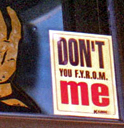
Instead, Greece, and the U.N. by default, have continued to call Macedonia by the name “Former Yugoslav Republic of Macedonia”. As former B92 blogger Lucy Moore points out, “It’s an awfully long name for a tiny country, but you can call it FYROM for short”. To which she adds: “With Greece still hung up on a name from the third century B.C., Serbia's 1389 claim to Kosovo suddenly seems more reasonable”.

Photo by Tigertweet, used with permission.
Now the dispute over the name of the former Yugoslav republic could jeopardize its bid to join the EU and NATO, both of which Greece is a member. An invitation to join NATO is expected at the summit of the organization to be held in Bucharest in April, and after Kosovo's declaration of independence last month, Macedonian officials say the country (which has a sizable Albanian minority) needs membership in the security organization, and later in the European Union, to maintain stability.
However, Greece has threatened to veto Macedonia's membership bid if it does not change its current name (Republic of Macedonia). In addition to NATO, Macedonia is hoping to start accession negotiations with the EU in the fall, based on an EU progress report released last week. The only problem could be, again, its name. In the words of the EU Enlargement Commissioner Olli Rehn, “If we can't settle this issue, I'm afraid it will have negative ramifications [for EU accession]”. Balkan Baby urges both sides to reach a compromise soon for maintaining stability in the region, with more flexibility on Greece's side:
Given the current instability which looms over the entire Balkan region, it seems highly irresponsible of the Greeks, as a relatively affluent country, to try and hinder the progress of Macedonia, a poor but democratically aspiring country which unlike Serbia wishes to bring itself closer to the West and encourages stability. Greek opposition is likely to infuriate Macedonian nationalists and this in turn could lead to a repeat of the bloody clashes that occurred in 2001 against the republic's Albanian minority. It seems that it is time for Greece to step down from its pedestal and start playing a more responsible and mature role in the region, something which for sometime it has tried to avoid as it promotes itself as a Mediterranean nation rather than being part of the Balkans. Out of defiance maybe Macedonia can ask for Greece to be forced to change its name to The Former Ottoman Hellenic Republic of Athens?
Dieneke's Anthropology Blog describes at great length the intricacies of the name issue, explaining why both sides have a right to the name:
The dispute centers around the issue of the use of the adjective “Macedonian”. This adjective has a geographical sense, describing someone who is from the geographical region of Macedonia. However, for the inhabitants of FYROM [Former Yugoslav Republic of Macedonia], it also has an ethnic sense, since many (or most) Slavic-speaking inhabitants of FYROM consider themselves to be Macedonian in an ethnic sense. […]
-The people of Greece are justified in wanting to deny exclusive rights to the Macedonian name to FYROM, because FYROM encompasses only part of Macedonia: geographically, the northern part; genetically, a subset of the Macedonian blood; linguistically, a Slavic dialect of the Macedonian region.
-The people of FYROM are justified in wanting to have some rights to the name Macedonian: they inhabit parts of Macedonia, they speak a Macedonian dialect of the Slavic group, and they have come to think of themselves as a separate nation from other Balkan Slavs.

Demonstration in Thessaloniki for the name change of the Republic of Macedonia. Photo by Pappalicious, used under a Creative Commons license.
Both Macedonian and Greek bloggers feel very strongly about the name issue, which external observers like Greater Surbiton, find hard to understand:
…it may be difficult for a sane person to understand what is happening here: try to imagine the English fighting with the Welsh over whether Boadicea was ‘English’ or ‘Welsh’, or with the French over whether Richard the Lionheart was ‘English’ or ‘French’. Try to imagine the French fighting with the Germans over whether Charlemagne was ‘French’ or ‘German’. This is something that no mature, democratic nation would do. Yet in the twenty-first century, it is apparently possible for NATO expansion and Balkan stability to be jeopardized over something like this. In fact, the implications are even more dangerous: if Slavs are not allowed to share in the heritage of Alexander the Great, are British citizens of West Indian or Asian origin allowed to share in the heritage of Boadicea or Richard the Lionheart ? Are German Jews allowed to share in the heritage of Frederick Barbarossa, or Italian Jews in the heritage of Julius Caesar?
UN envoy Matthew Nimetz, who is tasked with helping Athens and Skopje find a solution to their 17-year-old dispute, has been busy since last month, negotiating the search for a name acceptable to both sides. He recently presented a set of 5 possible alternative names and has been meeting representatives of both countries. The proposed names were: Constitutional Republic of Macedonia, Democratic Republic of Macedonia, Independent Republic of Macedonia, New Republic of Macedonia and Republic of Upper Macedonia. The proposals were not very well received: a few Macedonian blogs circulated petitions against a name change, thousands of people protested in Macedonia, and there have been similar demonstrations in Thessaloniki, the capital of Macedonia in northern Greece.
The blog Say:Macedonia, whose author considers that “it is a basic human right to choose a name for yourself and to express your nationality,” comments on one of the most popular proposals amongst Greek media in an open letter to UN envoy Mathew Nimetz:
In relation to “Upper Macedonia”, while the Greek government has indicated its willingness to agree to this name (as the Greek media has reported in the last few days), it should be pointed out that this name is inconsistent with its official position. If an “Upper Macedonia” exists then logically there is also a “Lower Macedonia.” Therefore having this in mind, how can the Greek government argue, among other things, that the name “Republic of Macedonia” has irredentist claims on northern Greece, but the name “Upper Macedonia” would not?

The Macedonian flag over the town of Ohrid
(Photo by rtw2007, used with permission)
As NATO's summit in April is approaching, time is running out for a deal between Skopje and Athens to solve the 17-year-long dispute, so a few bloggers have made themselves useful by suggesting alternative solutions to the dispute. Here is Greek blogger's Eugenia Loli-Queru idea:
The solution is to make both countries, a single country. Call it “Macedonia and Greece”, or call it “Macedreece” or call it “Greedonia”, I don’t really care. The point is, these two cultures have MORE in common than they think they do. Ancient Macedonians were very similar in their culture and religion with the rest of Greece. It takes guts to merge two countries, but it has been done in the past, and it can be done again, peacefully. […]
My final argument is this: both cultures adore Great Alexander, and each one wants the hero to be their exclusive hero. And yet, all Great Alexander wanted for both, was a united Macedonia-Greece. By not having the wisdom to merge after 2,500 years, neither of you deserve him as its hero.
Other bloggers like Florian Bieber think that, following Macedonia's name proposals, generally republics should be required to add meaningful descriptive adjectives to their names:
“Smallish Republic of Montenegro” (SROCG)
“Kinda Democratic Republic of Serbia” (KDROS)
“Democratic Federal and Sometimes Confederal Republic of Three Equal Constituent People and Nobody Else of Bosnia and Herzegovina” (DFSCRTECPNEBH)
Now there's even a Facebook group where you can contribute to finding a solution for the dispute by suggesting a suitable adjective for Macedonia, which includes proposals like Post-Modern Republic of Macedonia (PoMoSoMa), The Not Even Remotely, Honestly not even a little bit, Hellenic Republic of Macedonia (NERHNELBHRM) or Ajvarska Republika Makedonija (ARM).
Luis Polo Roa of Tu Politica [es] writes about and analyzes the elections for the new leaders of the Democratic Revolutionary Party (PRD) in Panama.
Bloggings by Boz has the latest presidential election poll numbers from the Dominican Republic and Paraguay.