Archive for
February 12th, 2008


Stories

National Sports: unique expressions of countrywide pride.Video post

Whether by government decree or by popularity, national sports are part of the cultural makeup of every country. People from many walks of life come together to participate, watch or root for their favorite athletes or teams. Check out which unique national sports Colombia, Japan, Malaysia, Indonesia, Qatar and United Arab Emirates have.

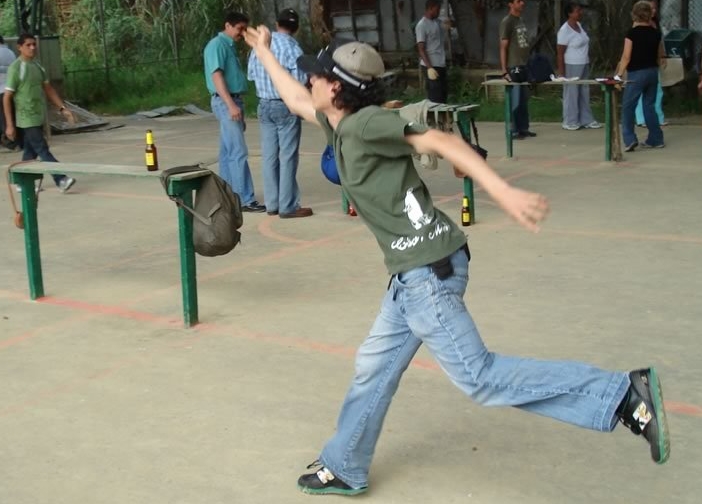
Tejo | Niguateros by Luis Perez

Tejo Niguateros by Luis Perez

In Colombia, ramiroparias [es] uploads the following video explaining the rules of tejo, a game which consists of throwing from a distance a 2 kg weight at a platform filled with clay in order to score points related to a circle incised on the clay surface with 4 chips called “fuses” around it. You can view a game in progress on this video uploaded by yecido.

In Japan, Sumo wrestling is the national sport. Sumo is a highly traditional and ritualistic contact sport where two wrestlers attempt to take the opponent out by pushing him outside a circle or by making them touch the ground with anything other than the soles of their feet. The following video by purnamabs shows a match that took place during November in Fukuoka, Japan.

From Malaysia and Indonesia we have Silat: a martial art/folk dance. User pssgmswk shares a presentation.

In Qatar and the United Arab Emirates, Camel Racing is part of their heritage, and now it has been brought to modern times. Before, small children as young as 6 were used to ride the camels due to their low height and weight. Nowadays, robots are being used to ride the camels, as you will be able to see on this video uploaded by qatarvisitor.

To view more countries with distinct national sports: check out oina in Romania, the charreada in Mexico, and Mongolian archery

Hindi: Water, dowry, the stock market and others

Global Warming is something thats affecting us all. But even in this regard there are different camps. Some believe that its a very important concern and something should be done about it while some believe that its not as big or critical concern as is made out of it and there are also some who don't believe at all that this is a critical concern! Dr.Mandhata Singh reports that Kolkata(erstwhile Calcutta), an eastern port city of India and erstwhile capital of British India, will submerge into Bay of Bengal in next 30-100 years if global warming and melting of Himalayan icecaps continues at the current rate. He says that a similar fate is likely for the Sundarbans according to a social organisation NEWS (which is working for the welfare of the Sundarbans) and Marine Science department of University of Calcutta.

Gyandutt Pandey narrates an evening's incident as he returns from his office and his chauffeur tunes into a phone-in film music show on radio and on that evening a girl phoned in and is over the moon having had her call connected to the show. The hostess of the show asks about her studies and plans for the future but in her high the girl blurts that she's worried about her marriage! The hostess gets a bit uncomfortable unsure how to handle this and she gives an idealistic advice that the girl should focus on her studies and then her career and she'll get married when the time comes. Now the girl realized that by speaking her mind truthfully she'd unknowingly dissolved some tension in a film music programme. The chauffeur also feels a bit uncomfortable at this and turns off the radio while Gyandutt gets thinking that dowry issues are still very much present in the society, newly wed women are still being murdered by being burned alive just because their parents failed to give the demanded dowry. But when asked people say that they want a good daughter-in-law and not dowry. And he wonders then why the girl concerned was about her marriage??!!

Ravi Ratlami is telling everyone how commands in Hindi can also be given now to the computer. He says that till now this feature was available only in Unix and Linux but now its also available in Microsoft Windows using a tool called PowerShell from Microsoft. He says that commands are still in English and if one wants to use the Hindi commands then aliases will have to be created for the corresponding English commands and he illustrates this with an example of how to create an alias for opening Notepad and then opening it by issuing the Hindi command. Similarly other unicode languages can be used with PowerShell.

And as it seems, things are not going well in Stock Markets around the world and same is the case with the two major Indian stock exchanges; BSE(Bombay Stock Exchange) and NSE(National Stock Exchange). As Sauda Bazaar reports, Anil Ambani headed Reliance Power's share was listed on Monday but it sent shockwaves through the market as BSE's main index recorded its 3rd biggest and NSE's major index recorded its 4th biggest loss. Buyers, both who were left out in the IPO and those who wanted to buy more, were disappointed as Reliance Power's share opened at Rs.530 (it went for Rs.450 in IPO) and then came down after that throughout the day. Its sister company Reliance Energy also fell big as its share began the day on Rs.1965 and after going Rs.20 up it continued its downfall and at the end of the day it closed at Rs.1582.30. Overall except IT companies everyone saw a further drop in their stock's value and its expected that this slide in the market will continue this week.

Links courtesy: Narad

Japan: Interview with Sasaki Toshinao by g86

There is no lack of mystery surrounding the Japanese cyberspace. From the conspicuous number of Japanese blog posts, to the contradiction of rabid anonymous flaming and conformist humble giants, to the overwhelming popularity of TV celebrities, Japan's net culture is a challenge to characterize, to say the least.

There is, however, a history to the Japanese Internet, one that in part explains and ties together its seemingly contradictory elements. A major theme in this history is Japan's so-called lost generation, those people currently in their late-20s and 30s who joined the work force just after the bubble economy burst in the early 1990s. Coincidentally, this was right around the same time that the Internet was making its first appearance in Japan.

In an interview last month, well-known writer and freelance journalist Sasaki Toshinao (佐々木俊尚), formerly of Mainichi newspaper, presented his own interpretation of this history. Sasaki's area of specialization is IT, a topic about which he has written extensively in numerous articles as well as many books, most recently “The Flat Revolution” (2007). The interview was conducted by a group of four third year architecture students at the Tokyo Institute of Technology who call themselves g86, referring to their shared year of birth, 1986.

In their shared blog, which they call “space journal” [ja], g86 conduct face-to-face interviews with, in their words, “people active in Tokyo with a broad view of urban space and life”. The interview with Sasaki starts with him explaining the factors leading to the emergence of Japan's lost generation:

佐々木氏—世代の話をすると、日本で90年代半ば91年にバブルが崩壊するんだけど、その時代は就職がきつかった。だいたいバブル世代っていわれているのはね80年代半ばくらいだから、今の会社の入社でいうと92年くらいまで。毎日新聞に、僕は88年に入社して同期が100人くらいいたんですよ。91、92年くらいには150人や200人で93年になると、一転して10人とかに激減して、そのころに就職活動始めた人はもうどこにも就職できない。しかも非正規雇用でしか会社で働けなかったりしてフリーターになってしまいワーキングプアに転落する人が非常に増えてきて、この世代がイコール、ロストジェネレーション、要するに日本で戦後初めての親よりも貧しい世代。だから今で言う35歳くらいの人、70年生まれくらいの人ですよね。

Sasaki: Speaking about generations, in Japan in the mid 1990s, in 1991 when the bubble burst, during that period employment became very difficult. When people speak about the bubble era, they usually mean the mid-1980s, and this lasted up until around 1992. When I joined the Mainichi newspaper co. in 1988, about 100 people joined at the same time. By ‘91 or ‘92, there were 150 or 200, but by ‘93 there was a complete change, it started to drop suddenly down to 10 people or so, and people who started job hunting during that period couldn't find employment anywhere. On top of this, the number of working poor — people able only to find temporary employment, who became the “freeters” — had increased a great deal; this was the “lost generation”, in short, the first generation of people in Japan since the war to be poorer than their parents. So these are people who are about 35 years old now, people who were born around 1970.

そのロストジェネレーションとインターネットの出現っていうのはほぼ同じ時期なんです。景気が悪くなったのが93年くらいでインターネットが日本で普及し始めたのが95年。二年遅れくらいでインターネットが入ってきて、ロストジェネレーションは社会ではひどい目にあいながらもインターネットを使って新しいコミュニケーションをはじめたと、いうのがオーバーラップして、マスメディアはおじさんたちの言論空間、でインターネットの言論空間はロストジェネレーションたちが軸になるっていう対立軸が発生した。

This lost generation appeared at just about the same time as the Internet made its arrival. The business climate turned sour right around ‘93, and the Internet started becoming popular in Japan around ‘95. The Internet entered the scene following a two year lag, and although the lost generation was facing a terrible situation in society, this [period] overlapped with them also using the Internet to initiate a new [kind of] communication, and with the origin of a confrontation between, [on the one hand,] mass media as the expression space of a discussion space for old men, and [on the other] the Internet as an expression space a discussion space with the lost generation at its axis.

例えば、それが一番鮮明になったのが一昨年の2005年。この年にライブドア問題と小泉の郵政解散があった。マスメディアはこぞってライブドアや小泉を批判したんだけど、一方ネットでは堀江、ライブドアを擁護するような声が少なくなかったし、小泉政権にしてもそう。ここで世代間差異が明確になってきて、そこでブロガーすなわちロストジェネレーションは、マスメディアは我々を代弁しているメディアではないことを明確に認識した。つまり世代間断絶があるっていうのがようやく可視化された。さらに結果的に小泉自民党は勝ってしまって、それまでインターネットは隅っこの方で、ちまちまやっていたのが、我々の言論が時世を変えられるんじゃないっていう希望が生まれてきた。だから2005年というのはインターネット言論にとっては記念碑的な年になった。

For example, this became the most vivid two years ago, in 2005. In that year, there was the Livedoor scandal as well as Koizumi's dissolution of the postal system [postal reform]. While the mass media was unanimously critical of Livedoor and Koizumi, on the net there were more than a few voices defending Horie and Livedoor, and the same for the Koizumi administration. It was here that the difference between generations became clear, and at this point bloggers — in other words the lost generation — recognized very clearly that the mass media was not media that acted on their behalf. In other words, the fact that there was a discontinuity between generations was brought out in visual terms. And then on top of this, Koizumi's Liberal Democratic Party ended up winning, and the hope was born that the views of Internet users, up until then doing their little thing in the corner, could actually change the times. So 2005 was a monumental year for expression on the Internet.

その後も、例えばマスメディアは電車の中で携帯いじっている奴らが馬鹿だとか書いたりするんだけど、今まで電車の中で本を読んでいたのが、単に表現メディア、つまりデバイスが変わっただけの話なのに、そういうのがおじさんにはうけるだろうと書いたりした。でも彼らはインターネットの言論空間で何が行われているかは実際知らない。ブログも読んでないし。ブログの世界って言うのはポータルではない。つまりこれを読んで全てわかるっていうのがない。だからよそ者、慣れてないリテラシーの低い人には入りにくいっていうのはあって、彼らは全然接していない。

After this, the mass media would for example write that those guys typing away at their mobile phones on the train are stupid, while the reading of books on the train, which had always happened, was treated as just [a form of] expression media; in other words, although only the device had changed, [the mass media] wrote [these things] because they knew they would be popular with old men. But these people [in the mass media] in fact knew nothing about what was happening in the expression discussion space of the Internet. They didn't read blogs. The world of blogs was not a portal. In other words, it was impossible to “read this and understand everything”. Therefore for outsiders, those unaccustomed and with poor literacy, it was hard to enter [this world], and they had absolutely no contact [with it].

一方でロストジェネレーションの人たちは、テレビとか新聞を観ても馬鹿じゃないとしか思わない。朝のワイドショーのコメンテーターの言うことに、膝をうつこともほとんどない。逆にブログを見ると、もっともだなと思える人がいて納得したりする。そこでもう完全に言論空間に分断が起きてしまっていてお互い相容れない状況がおきている。

On the other hand, people from the lost generation would look at television and newspapers and just think, how stupid [are these people]? Watching commentators on the morning talk shows, there was almost nothing to strike a chord. Looking at blogs, conversely, many found points that made sense, and that they could agree with. There again, a complete subdivision of the space of expression occurred, and with them circumstances of mutual incompatibility.

Later in the interview, Sasaki uses the Japanese concepts of “seken” (世間) and “kuuki” (空気) to explain changes in Japanese society and the nature of the Japanese blogosphere:

佐々木氏—最近注目しているのは「空気感」というキーワード。インターネット上にある「空気感」はその中にいる人間にしか可視化されていない。それでは、サークル外の人間はどうやって可視化していくのかっていうことは重要な問題なんじゃないかと思いますね。ブログってそこがある程度可視化されているような気がしますね。テキストの形式でみんな顔文字なんかも使ったりして。それでもう一段階ですよね。行間から滲みでるような何かを作って、それが言語なのか記号なのかよく分からないですけど、それによって可視化されるものには可能性がありますよね。それはブログだけじゃなくて、それこそ空間だとかメタバースとかそういうものも含めて、そこに漂っている空間をどうやって可視化していくのかっていうことは重要だと思います。できれば「空気感」さえ検索可能になればすごくいいですよね。

Sasaki: Recently, I have been paying attention to the keyword “kuukikan” (”sense of air”). This “kuukikan” on the Internet is visible only to people who are inside it. The problem that I think is then very important is the question of how those outside this circle of people can begin to visualize [the “kuukikan”]. Blogs, I have a feeling, are [places] where to a certain degree this is being visualized. Using emoticons all from the form of text, this is one more step. Creating things which seep through the lines of text — they can be words or symbols, or whatever — but there is the possibility of something being visualized through them. What is important I think is how to visualize the atmosphere that hangs in these places, not only blogs but precisely these kinds of spaces, metaverses and so on. I think it would be fantastic if only it became possible to search the “kuukikan”.

g86—それはすごく面白い!

g86: That's so interesting!

鎌谷—かつて日本にあった「世間」というものはもう無くなって「空気」にシフトしたんじゃないかなと考えていて、例えば最近だと「KY(空気が読めない)」だとかそういう言葉が世代を越えて定着していたりして、現代の社会に「空気」というものがキーワードになってきていることは言えると思います。

Kamatani: The “seken” that was once in Japanese society has disappeared, and it has shifted to “kuuki”, this is what I'm thinking. For example, expressions like “KY (kuuki ga yomenai / can't read the air)” have recently crossed generations and established themselves, and I think you could say that this thing called “kuuki” (”air”) has become a keyword in modern society.

佐々木氏—「世間」というのは高度成長モデルであって、みんなが共通基盤をもっている時代の「空気」が「世間」と言われていたんだけども、今は全員が同じ共通基盤をもっていないから、空間がセグメンテーションされて、小さくなっているんですよ。それぞれの中にある「世間」に小さい「空気」であるだけで。そこでみんなが共通の「空気」ってあり得るのかどうかとか、そういう小さなセグメントと隣のセグメントが滑らかにコミュニケートできるのかどうかとか、色んな問題が起きてきて、そういう状況になってきたのはここ10年ぐらいの話だね。80年代はみんな同じ共通基盤をもっていて、やっぱり97年ぐらいが境になっていて、それ以降は新しいモデルを作り上げないといけないんだけどまだそこがしっかりと基盤が整っていないというのが現状だと思いますね。97年に何があったかっていうと山一証券が倒産して、通貨危機が起きたんですよね。

Sasaki: What is called “seken” is an economic growth model, and in an age in which everybody shared a common foundation, “kuuki” was referred to as “seken”. But nowadays, people do not all share the same common foundation, so the “kuuki” is being segmented, and growing smaller. These are just the little “kuuki” inside each “seken”. Whether there can be a common “kuuki” between all of them, and whether one small segment can easily communicate with the neighboring segment, these various issues have come up, and this is the state of affairs we have come to over these past ten years. In the '80s, everybody had the same shared foundation; it was of course ‘97 that became the dividing line, and after that it became necessary to construct a new model, but as it stands today, this [new model] is not yet a reliable foundation. What happened in ‘97 was that Yamaichi Securities went bankrupt, and this sparked a currency crisis.

g86—なるほど。

g86: I see.

佐々木氏—戦後経済の枠組みが消滅した年なんですよ。その数年前の93年には自民党が野党になったり、高度成長モデルが終焉したんです。だから97年を境に「世間」が「空気」に変わったと言えると思います。その新しい社会がどうやって我々の恒久性みたいなものを形成していくのかっていうことがすごく重要な問題だと思います。だから「国家の品格」とかが売れるのは昔を懐かしむ気持ちがみんなにあるからだと思いますね。「3丁目の夕日」だとか。

Sasaki: That was the year that the post-war economic framework ceased to exist. In ‘93, a few years earlier, the Liberal Democratic Party became the opposition party, and this was the demise of the economic growth model. So I think one could say that ‘97 was the dividing line, [the point] when “seken” became “kuuki”. What became the extremely essential issue was the question of how this new society would formulate a kind of permanence for the younger generation. So the reason that things like “The Dignity of the Nation” could sell was I think that everyone had feelings of nostalgia. “Always - Sanchōme no Yūhi” as well.

小林—そのようにインフラが劇的に変動しているこの時代で佐々木さんはジャーナリストとして、どういうスタンスで、どういうことを目指してらっしゃるのですか。

Kobayashi: In this age, where the infrastructure has changed so dramatically, what is your stance as a journalist, and what kind of things are you aiming for?

佐々木氏—それはさっき言った「空気感」なんですよね。「空気感」が何をやろうとしていて何を目指しているのか、どういう風に作り上げられているのかとか、「空気」の中にいる人たちは自覚していないわけですよね。その「空気」を活字として固定化する作業をやっているということですね。それが自分の仕事かなと思います。僕にとってジャーナリズムっていうのは時代の「空気」をいかに言葉として定着させていけるかどうかっていうそこのトライアルの連続ですね。

Sasaki: That would be the “kuukikan” I just mentioned. What is the “kuukikan” trying to do, what is it aiming at, how is it being built up — the people within the “kuuki” (”air”) are not self-conscious of these things. The work they are actually doing is that of fixing the “kuuki” in the form of printed words. This is what they think of as their work. For me, what is called journalism is the continuous attempt to somehow fix in words the “kuuki” of the era.

小林—新しいことは下の世代から生まれることが多いと思うのですが、そこでのご自身とその世代間の価値観の相違などで理解に苦しむ事などありませんか。

Kobayashi: There are many new things being born from the generations of people younger than you, so I'm wondering, are there any inter-generational changes in values, and so on, that you struggle to understand?

佐々木氏—僕は今46歳。ネットで活躍している人っていうのは、40代はほとんどいないんですよ。だからそもそも同世代感は無いんです。あまり僕はそういうことは考えない。いかに冷静に分析できるかということに尽きると思いますね。今ケータイ小説の取材をしているんだけども、僕は別にケータイ小説は好きじゃない(笑)ケータイで書いたり読んだりしている人が何を考えているのかっていう時に分析していけばそこから何かが見えてくる。ケータイにのめり込んでいる中高生と僕との相違でいうと、彼らは「空気感」とかに対して身を持って体験していて強いわけですけど、彼らには歴史感とか社会感は無い。僕の方がそれはある。だからそこに基づいて、何でここにこんなモノが存在しているのかっていうことを分析していく。それこそがジャーナリズムですね。

Sasaki: I am now 46 years old. Of people active on the net, there's almost nobody in their 40s. So from the start, I do not have the same sense of generation. I don't really think about that kind of thing. It comes down to being able to analyze calmly, I think. I cover right now keitai shosetsu [short stories on mobile phone], but I don't particularly like them (LOL). Something becomes visible from analyzing what people think when writing and reading keitai shosetsu. The difference between middle and high-school students absorbed in keitai shosetsu, and myself, is that while their strength is that they have experienced first-hand the “kuukikan”, they have no sense of history or sense of society. In my case I have these. So based on these, I attempt to analyze why these kinds of things exist. This is precisely what journalism is.

East Timor: Democracy under siegeVideo post

Yesterday's attempted assassinations in East Timor would presumably have been followed by a political and military coup. Today Acting President Vicente Gutterres announced a curfew and two-day state of emergency on a TV address this Tuesday, and 120 Australian soldiers and 70 federal police sent to help with security and peacekeeping began arriving in Dili the same afternoon.

Timor-Leste President Jose Ramos-Horta was wounded yesterday morning at his home and later transferred to Australia's northern city of Darwen for medical treatment. He remains in an “extremely serious but stable” condition. Prime Minister Xanana Gusmao was unhurt in a separate attack soon after the gunfight at Ramos-Horta's home. Major Alfredo Reinado, one of the 600 mutinous soldiers dismissed by the government in 2006, was shot dead inside the president's residency, and according to his supporters an hour earlier the attack on Ramos-Horta.

Bloggers have been busy reporting on the situation on the ground, echoing news, trying to get extra information and worrying about the future of the democracy in the tiny island, which has only been declared an independent state in 2002. Margarida [pt] uploads a video from YouTube user rincondelucha which shows an interview with Major Alfredo Reinado, uploaded a day before his death, in which he says he was prepared to sacrifice his life for his people and country. The interview is in English:

Lena Lorosae [pt] leaves readers with a question for reflection:

A quem interessava “decapitar” o sistema político vigente em Timor, com o Presidente do Parlamento fora do país ?… Dá que pensar…

Who would be interested in “decapitating” the existing political system in Timor, with the President of Parliament out of the country? … It makes one wonder…

Timor Online [pt] adds some more questions that remain unanswered:

Quantos furos de bala tinham os três carros que foram emboscados da comitiva de Xanana Gusmão, depois do ataque a Ramos-Horta, incluindo aquele em que seguia, o tal que “foi completamente destruído”?

Quem alvejou Ramos-Horta, que foi encontrado de bruços, atingido pelas costas, na rua à porta da sua casa? Porque quando lá chegou, já Alfredo Reinado estava morto dentro de casa no jardim com um tiro no olho e outro na mão…

Perguntas difíceis de fazer?!

How many bullet holes the three cars that had been ambushing Xanana Gusmao's convoy had, after the attack on Ramos-Horta, including the car which followed him, the one said to “have been completely destroyed”? Who fired on Ramos-Horta, found face down shot in the back on the street next to his front door? Because when he got there, Alfredo Reinado was already dead inside his home, in the garden, shot in the eye and in the hand … Too difficult questions to ask?

Timor Online has been compiling pieces of news in both English and Portuguese about the incident. Among them, there is Lusa a piece on the criticism by former Portuguese ambassador in Indonesia and Member of European Parliament Ana Gomes about Major Alfredo Reinado, according to her “a criminal and unbalanced person” to whom Timorese, Australian and UN authorities were “too appeasing” in dealing with and therefore to be blamed for. She recalled that Reinado was the central figure in the political and military crisis in May 2006. A comment left on this post by H correia [pt] says she was a little bit too late to react to the actual political situation:

Durante cerca de um ano e meio, este e outros blogues,bem como muitas indivualidades timorenses andaram a dizer isto mesmo, perante o autismo irredutível de RH, XG, Atul Khare, comandantes australianos, e… o silêncio da Lusa, da imprensa portuguesa e da própria Ana Gomes. É pena só agora a Srª eurodeputada ter dito isto. Agora é tarde e é fácil ir com a maré. Devia ter falado há mais tempo, quando esteve tão calada perante as ilegalidades cometidas por XG e RH.

For about a year and a half, this and other blogs, as well as many Timorese people, have been saying it in the face of RH, XG, Atul Khare, Australian commanders' irreducible autism… and about the silence from Lusa, the Portuguese press and the very Ana Gomes. It is a pity only now Ms MEP have said that. Now it is too late and it is easier to go with the tide. She should have spoken earlier, when she was so quiet in the face of the illegalities committed by XG and RH.

(RH = Ramos Horta, XG=Xanana Gusmao, Atul Khare is the United Nations Special Representative for Timor-Leste)

On publishing a piece of news that Prime Minister Kevin Rudd will fly to East Timor this week after boosting Australia's military presence in response to the crises, Timor Online [pt] left a footnote:

Como será possível alguém acreditar que mais umas centenas de incompetentes de militares australianos e polícias federais, conhecidos pela sua falta de respeito às instituições timorenses, alvos de queixas e processos crime por desrespeito e desobediência ao sistema judicial timorense, vão resolver o que quer que seja?

How can someone believe that a few more hundred of incompetent Australian military and federal police officers, known by their lack of respect for Timorese institutions, target of complaints and criminal processes for disrespecting and disobedience to the Timorese judiciary, will address whatever problem there is?

Mane Kribas, from Timor Lorosae Nação [pt] is also sure that Timor does not need any help from Australia:

NÃO, NÃO PRECISAMOS DE MAIS MILITARES AUSTRALIANOS EM TIMOR-LESTE, precisamos, isso sim, de esvaziar substancialmente o seu domínio para que venham para Timor militares competentes de países insuspeitos de nos quererem fazer seu capacho.

NO, WE DO NOT NEED MORE AUSTRALIAN MILITARY IN EAST TIMOR, what we need, indeed, is to substantially undermine their domination so that only troops from competent countries that do not want to make doormat of us will come to Timor.

Cláudio Francisco [pt], who used to live in East Timor when it was a former Portuguese colony, says it is time people woken up:

Os últimos acontecimentos em Timor não são de todo uma grande surpresa, pois algo estava na forja há muito tempo. A surpresa foi a magnitude das ações. Esta é uma opinião minha e formada a partir de detalhes conhecidos através da imprensa internacional nas notícias de última hora e que associei ao que de estranho se passou durante muito tempo com relação ao major Reinaldo. Afinal, foragido da Justiça e conhecido o seu paradeiro por muita gente importante, porque razão nunca se colocou côbro a essa situação esdrúxula? Será porque os australianos lhe davam cobertura?— Mas, se assim é, a gravidade da situação é muito maior, pois deduz-se haver conivência no que se passou agora. Muita coisa terá que ser descortinada e os timorenses teem direito de saber o que acontece no seu País.

The recent events in Timor don't come at all as a big surprise, because something like this was in the pipeline for a long time. The surprise was the actions' magnitude. This is my opinion made up from details known through the international media and in the last minute news, which I have pieced together with the odd things that have happened for a long time regarding major Reinaldo. After all, he was an outlaw whose whereabouts were known by many important people, why this freak situation was never put to an end? Is it because the Australian backed it? — But if so, the gravity of the situation is much greater because it can be concluded that there is connivance with what happened now. Much will be revealed and Timorese people have the right to know what happens in their country

Background

East Timor, a former Portuguese colony with almost 1 million people, is the Asia's newest nation after winning independence from Indonesia in 2002. Ramos-Horta, 58, won the 1996 Nobel Peace Prize for his nonviolent resistance to the Indonesian occupation, campaigning in exile to highlight Indonesia's military rule. Previously, East Timor had been a Portuguese colony since the 16th century.

In March 2006, there was an outbreak of violence and political turmoil in Dili when security forces shot and killed five people, which in turn sparked more violence, rioting and looting for several days. More than 150,000 were displaced and 37 people died between April and May 2006 after clashes between factions within the East Timorese security forces.

Uruguay: File Sharing Site Raises Questions

Editor's Note: The following is a translation of an interview conducted by Uruguayan blogger, Martin Balao. He interviewed the blogger nicknamed E1000, who is one of the driving forces behind the community site Fotos de Uruguay [es] (Uruguay Photos), which began as a community photo sharing site and now provides downloads to Uruguayan musical artists. The link to the original article can be found on Martin's blog.

1. When, how, and why did Uruguay Photos come about?

When I went to Spain, as most immigrants do, I began to miss my country. When one experiences this, the firs thing one does is to try to take the country with you. You want to take everything that you want to see, touch, smell and hear from your country. When I entered the internet to look for things, I was very disappointed. In 2003, there was nothing online about Uruguay, so I decided to do it myself.I didn't have the slightest idea on how to make a site and blogs were not as popular as they are now. I began with a little bit of HTML and I created my first page. It was only one page, then I found scripts to make photo albums and there Uruguay Photos was born. I belonged to various mailing lists and I asked everyone to send photos. I had the the photos, but few visits. I knew that I needed to become friends with Google, and Google likes words, not photos. I visited PHPNUKE, a site where in addition to photos, there were other interesting things. I began to collect links to newspapers and radio stations that broadcast over internet, and the music began when I got to know other immigrants. Rapidshare, Megaupload or other places to host files did not exist. I installed a Tracker for Bit Torrent, and then Miriam and I started to have 1000 shared files by Bit Torrent and eMule, and so then the direct downloads.

2. What is the significance of the name and why an Argentine domain?

Its name comes from the fact that it started as a photo album, and the domain .ar is due to the fact that the domain is free. A Uruguayan domain is expensive. We had a .tk domain, but it bombards you with ads and popups

3. Could you provide us with some figures about the site's activity (visitors, traffic, messages)?

Well, we have more than 5,000 unique visitors per day, some 20,000 page views, very few messages. Before, when we had the downloads, many people downloaded and left. Now, we have a little more activity in the forums.

4. What resources are needed and what are the costs associated to maintain the site?

How have you dealt with the funding?I don't know about materials, but you need a pair of computers connected to the internet all day for maintenance, uploads, downloads, etc. The cost for the server is taken care of by Mirian, who pays from her own pocket. We also need some premium accounts in the different servers, but without a credit card I cannot pay. Uruguay has many problems with online payment. No bank has given me the solution on how to pay for an out-of-country service, without charging more than what the actual service costs itself.

5. What has been your experience with PHP-Nuke?

Nuke is great. It helps those that don't know anything. Ha ha. It is very difficult to select a CMS (Content Management System), each has something that you are looking for, but none has everything that you want.

6. Who makes up the staff and how do you distribute tasks?

The staff is Mirian. The works is distributed between Mirian and Mirian. Ha ha. Seriously, I won't give names because there are many and you can be seen in Uruguay Photos, such as moderators, uploaders, and others. In the end, it is an interactive site, and anyone who wants to help can do so in one way or the other. The one that is working 8-12 hours a day is Mirian.

7. What challenges have you had in relation to the users?

Interacting with the users is a very complex. It is difficult to please 35,000 people. Every day I get messages with instructions on how to administer the site. It's like football, everyone has a different lineup.

8. Have you had legal problems with the exchange of content due to copyright?

Have you been contacted by an artist? What are your thoughts on this?Cudisco approached us asking us to remove the direct download, only those songs from DSUS4 (a Uruguayan band) or something like that. They have asked us to remove their album and we did. We are not here to bother the artists and I don't think that we do. No one knows the exact amount that the artist loses with each album. They also do not know how many artists have been discovered through the internet. If I need to pay 300-400 pesos to listen to an album, I probably won't do so if I only make 200 pesos per day. Another problem is that in Uruguay, the artists do not reach into the interior of the country. I live in a town of 15,000 residents and there are no record stores. A couple of businesses have 10-20 CDs, but they are by international artists. Here no one risks bringing a vinyl album. I become familiar with artists on a daily basis because of Uruguay Photos. The radio stations in Montevideo do not reach us or are not listened to. An artist once said, if my album is not on the internet it is because it is bad, I don't know. I think the question is: if we get rid of downloading, will bootlegging disappear?I want to be clear: only 1 asked us to remove their albums, and about 12-15 asked us to put their album on our site. Pepe Guerra shares his album on his website, is this self-bootlegging? In Uruguay Photos, albums have been shared that the newer generations would never have had heard. 3 famous musicians congratulated us. There are many more musicians that are users on Uruguay Photos.

9. What are your plans for the future?

Making plans in an area where the changes are constant is very adventurous. When the services of direct download began, everything apperaed that it would be simple. Instead we have a guy that reports 300 or 400 albums at one time, and that changes all the plans.

10. Anything else to comment?This project is done only for a pat on the back. It is not-for-profit, it becomes tedious, it tires, it frustrates, but we continue because of the thanks from a fellow Uruguayan throughout the world.